Tuesday, May 29, 2012

Granny Squares


I rarely do any stitching purely for personal purposes. It's so time consuming, and when I'm working on big art projects with deadlines it just doesn't make sense spend hours of stitching time crocheting myself a hat.  But sometimes I do make an exception for my most beloved darlings: especially my daughter, who had a birthday last month.

I've had granny squares on my mind for a while because a) they are quite fashionable so I keep seeing attractive photos of granny squares and b) they are fun and easy to crochet.  I'd love to make a vibrant multi-coloured granny square-something one day, but for Louise's elegant taste I restricted the palette to blue and grey. I knew she wanted a small blanket to keep her lap warm while studying in her cold Melbourne flat, and I hoped I could piece it together with op-shop wool because I was really broke.

I had the blue mohair, and some bits of grey wool already in my stash and I became a determined searcher of op shop wool baskets for a few months.  It was only as I came to sewing up the squares that I completely and utterly ran out of wool and had to go buy a whole skein new.  It was surprisingly difficult to find a warm grey in a light weight even once I broke down and started looking at yarn shops as well as second hand. Apparently no one makes hand knit boys school uniform jerseys anymore.


Tuesday, May 22, 2012

Yummy Yellowcake

Yellowcake

I sort through bags of yarn passed on by a family friend clearing out her craft stash.

Ugly yellow acrylic sits on top of my reject pile while I'm telling my mother about the book I'm reading, Uranium: war, energy and the rock that shaped the world by Tom Zoellner.

I've been thinking about how I could make nuclear power or a radiation leak for a long time, at least since the Japanese tsunami.  That's where my thinking about clouds started before veering off into Dispersant.

Yellowcake, I say to mum, such an innocuous word. Yellowcake is the standard form for safely transporting uranium over long distances from mine to enrichment plant to be converted to fuel pellets for nuclear power plants.   The yellow yarn glows at the edge of my vision.

I sneak the yellow yarn into the bag of wool I'm taking home with me.  The yellow is too bland in its brash brightness. I dye hanks of it in tea, taking some out in minutes, leaving others in overnight so that now I have five subtle shades looking more interesting all together.

I've been thinking about stitching mines straight into plinths and blank stretched canvases.   I can try it out with my ugly yellow wool on the little square canvases in my cupboard.  I start sketching scrabbly and powdery piles and films and cakes of dust.

Couching

How will I stitch my yellowcake? I need a whole new technique.  I get another book off the shelf, The Art of Embroidery by Francoise Tellier-Loumagne seeking inspiration and find it in couching.

I have never couched before, but I don't read the directions, I just look at the photo for a while and then I do it. Which is usually how I figure out new stitches. Why is it so easy for me to learn textile craft techniques and so difficult to learn other useful things like science or accounting or colour theory?

A scattering of uranium

Wednesday, May 16, 2012

Making Many


A new project in memory of the 29 miners who died inside Pike River Coal Mine two years ago and whose bodies still lie buried in the dangerously gassy tunnels, to the great distress their families.


I'm making 29 of these mounds, small versions of Spoil which was also about coal mining. I've completed six so far. I can make one in a day which makes a nice change from my other long slow projects.  


My thoughts as I stitch these pieces are less about environmental impacts and more about the social costs of mining, one of the most dangerous industries in the world.  An estimated 5000 miners die in Chinese coal mines every year.  Over history, New Zealand has had several mining disasters which have reverberated widely through our small population.  The lies that communities are told about the wealth that mining will bring to locals must be cold comfort to families grieving for their men or caring for loved ones disabled by the job.  The imperative for mining companies to return increasing profits for shareholders is too often at the expense of safety.


Its a sad somber project but also very peaceful to work on. It fits on my lap and there are no tricky design problems to solve. Just the soothing steady push of needles into wool and through blanket.   I turn to this work for relief from the challenges of my other more technically demanding projects and gradually the collection grows.


Saturday, May 12, 2012

Last glimpse of the back


One of my projects at the moment is tidying up the back of Just a Little Spill. This involves fitting a backing cloth mostly to help bear the weight so that that the hand embroidery at the top is doesn't tear from the pressure of four kilos of blankets hanging below.  As usual I'm quite fond of the back of my work and like to document it before it disappears.    

The other job is blanket stitching a line or two on the back around the whole circumference, to try and keep the wayward black roving in check. My felting is pretty loose on this piece and it has a tendency to shed black fluff from the bits not held down with blanket stitch.


Just a Little Spill is so big (2.5m x1.5m) that its all but impossible for me to work on in my tiny studio.  My friends Bethwyn and Steven are very kindly letting me come round and use their large living room to spread Just a Little Spill out and work on these finishing touches.

Thursday, May 03, 2012

Just a little challenging

Me and Just a Little Spill (to give you a sense of scale)
Last week, in a mad rush to finish the stitching on my big black oil spill, I spent ANZAC Day sitting on my bed embroidering for 12 solid hours.  As I stitched I watched the entire fourth series of Mad Men on DVD on my laptop.  I enjoyed Mad Men very much. I finished Just a Little Spill which was very good. And I fried my laptop which was very bad.

The mad rush to finish Just a Little Spill was due to tomorrow's deadline to submit an online entry for it to the National Contemporary Art Awards.  An online entry requires one to have a computer and right now I don't have one.  Thanks to my mother letting me use her Macbook I have been able to submit the entry in time but its been extremely stressful to prepare.

Thankfully I'd already organized with photographer Craig Brown for him to photograph Just a Little Spill in his big studio. I found Craig online and chose him because he is the only local photographer who specializes in photographs of things (like cars) rather than people. He was an excellent choice, not only because he had the space and all the gear to manage my enormous black on black on grey, very difficult to photograph, work, but because he is very patient and experienced.  I'm so pleased with the pictures he took for me. Since I didn't have access to my own photos or Photoshop it was a great relief to have such a good full image that a detail view wasn't really necessary.

I've ordered a new desktop computer which will be more impervious to my studio's constant cloud of blanket dust (the original source of the overheating problem that after a year finally fried the laptop beyond repair).  My computer guy thinks he'll be able to retrieve about 95% of my data from the laptop, which will hopefully fill the two month gap since my last backup (let this be a cautionary tale that makes you do a back up right now!).  With luck, I'll be back online at home within the next few days.

Tuesday, April 17, 2012

Dispersant

View of Dispersant through the window from the ally. It doesn't photograph well because of the reflections. But its lovely in real life so if you can go, please have a look.

I installed Dispersant at the Outeredge Project at Sanderson Gallery last week and I'm really pleased with how its turned out.  But there is no chance to rest on my laurels or even have a cup of tea and a lie down. I'm running out of time to finish my big black oil spill and my Tui mine in time for their near deadlines, so I'm stitching even more constantly and certainly more frantically than usual.  So, not much blogging over the next little while.


Me on a plinth in the window installing

To keep you entertained click through to read two essays that accompany Dispersant. Fiona P. McDonald, an anthropologist has written a very erudite analysis, and I've got my own essay/artist statement.

Side view by day


Fiona writes: Experiencing Dispersant through the gallery window as though through the optic
lens of a microscope highlights the need for focused— rather than dispersed—accountability and an 
understanding the interconnectedness with unseen environments. This installation offers a new visualization and experience from which to negotiate alternative cosmologies in the aftermath of manmade environmental disasters. 


Side view by night

By the way, Dispersant is for sale, either as a complete work or as individual strands.. Please contact Sanderson Gallery if you are interested.

Tuesday, April 10, 2012

Friday, April 06, 2012

Call and Response


The lovely Sculpture Park at Waitakaruru Arboretum has a new exhibition on for Autumn: call and response, curated by Kim Paton and featuring all early career artists. I walked around last week and really enjoyed myself. It is a very fun show with lots of playful interactive pieces.


Taarati Taiaroa's Site drawings involves borrowing a pair of scissors and buying an envelope printed with instructions for foraging from trees around the park.  I chose kahikatea and enjoyed sweet little red berries.


Grace Tai's Sound Hunt : Traces was even more fun with a treasure hunt  for brightly painted boxes hidden around the park, some making a doorbell noise to lead you to the others which had log books, postcards and photos to take in exchange for some small gift back. I made little origamis out of bright gum foil wrappers and took some lovely images home with me.


Another interactive piece was Amber Pearson's happiness tree and good luck gravel. Both demanded some energetic hard work on the hand pump to bring the sculptures up to standing.  This is me pumping up the happiness tree, always a worthwhile endeavour. Good luck gravel shed silver glitter as it grew and I didn't like it so much, perhaps also because of the large bush cockroach than ran out of its folds very close to my face.


Blankets featured in a couple of the pieces, the most successful I thought was this (untitled) by Karen Burns in which the folded blankets lined a large wooden box with a (replica) 1853 musket, a bible in Maori and some beer bottles.  The blankets were all folded with their lovely vintage labels showing, and since I have a thing about blanket labels I photographed each of them individually.


I'm fascinated by the industrial history of the gravel quarry that transformed the landscape at the site before it was planted up by the current owners, so I appreciated Ryan Monro's RIP Greywacke in which little boxes with a big chunk of gravel were scattered inconspicuously around the edges of the quarry.


At the bottom of the quarry Veronica Herber's Slowness Shifting II was a lovely subtle cascade of masking tape down the rocky cliff face and across the path.


Two of the artists I am most familiar with in the show were tucked into the shady forest edges.  I've seem many photographs of Nell Nutsford's Mould, erosions and extrusions but to see them in real life set in the landscape was a whole new experience.  As large glossy photos in a white gallery they seemed purely conceptual, but in among moss and lichens they seemed like they were a new kind of alien plantlife growing our of the gravel.


I met Ross Forbes last month at the opening of Sculpture and Object at Sanderson Gallery where we both had work.  Once again, his signature style was transformed away from the gallery into something much more organic.  With his shards of mirror reflecting foliage instead of walls, and the balance of ropes and weights seeming more precarious on a rocky hillside, and the whole thing covering a much bigger space, I found "clash crash bang" very beautiful and exciting.

There's lots of other work in the show that I liked, and very little that is predictable or boring.  If you are in the Waikato I'd recommend checking out this show before it finishes on 10 June.  I think it would be great to take children around and even people who aren't usually that interested in art would, I think find it stimulating.

The image at the top of the post is  part of a zombie woodland creature picnic, Antoinette Ratcliffe's Freeze Sucker.

Saturday, March 31, 2012

Lovely for me

A strand of Dispersant, casting night shadows on the studio wall

In preparation for installing Dispersant in the Outeredge Project window in just a couple of weeks I am attaching my 400 crocheted, dyed and starched globules to fishing lines. I keep coming up short whenever I run out of the strips of old sheet and duvet cover that I use to carefully wrap each strand so they don't tangle in their boxes (five big boxes full so far).  So sometimes a strand of globules is left hanging in my studio for a day or two.  At night my bedside lamp is well positioned to cast lovely shadows through the globs. It is incredibly beautiful and I'm afraid I am the only person who will ever see them looking like this.

I feel sorry for (most) people who only get to see my finished art works in galleries because there are so very many moments of loveliness in the making and you will never know them as I do. I try and share as many work in progress (wip) photos here as I can, and often I continue to use wip photos after the piece is complete, because they remain my favourite images. But if I stopped and took a picture every time I noticed the transient loveliness under my hands I fear I would be even slower than the outrageously slow artist that I am anyway.  So most of my delight unfolds hour after hour in exclusive solitude.

Much of the loveliness can't be captured in photos, and I'm sorry, not matter how I try, my words are inadequate. How can I share with you the feeling of pulling floss through plump felted layers of blanket? The shushing of cotton and wool fibres stroking past each other until I sense just the right tension has been reached, the stitch is complete and the smooth point of the needle probes into the dense softness to begin the next stitch.  Over and over and over again, in a rhythm governed by the ever shortening length of thread, which begins as long as my arm can stretch from my lap and ends as short as the needle.  The trance is broken, I stitch the knot, snip the ends, pull another three strands of DMC off the card and thread the needle.

That's the pause when I am most likely to look beyond the row I am stitching to see the whole of what I've made so far.  Sometimes, especially in the long middle of a big project it's not lovely at all.  There's an awkward adolescence in which the charms of beginning are exhausted and the satisfaction of maturity seems a long way off. But I love the first stages of all my pieces as fiercely as a mother loves her newborn baby.  And coming to the end, seeing my vision made manifest the pieces look as intensely gorgeous to me as they ever will. More than the finished piece will, because once its finished I am stuck with all the little flaws and disappointments I have settled for.  No more potential, and to me, potential where the real beauty lies.

Monday, March 26, 2012

Blizzard Wins an Award

Blizzard (2011)
I won an award!  One of the four 2012 National Contemporary Fibre Arts Awards, the one sponsored by the Nelson City Council for 'the work which best embraces the theme of 'Water and/or Light'  The winning work is Blizzard, part of my Antarctica series.

The judges "felt that there was a lovely subtlety in the work, and that we loved the feeling of disappearing into the blizzard which the depth of the work gave.We also liked the contemporary interpretation of the quote, and the choice of fabric."

I am deeply moved by this Award.  I got a bit hysterical when I first found out, laughing uncontrollably as I conquered my surprise to let the news sink in. Then I started to cry a little. And then, because I had a busy day planned I had to just get on with what I had to do.  But every time I remember this exciting news I roll through another emotional response.   Here are three reasons why it is affecting me so deeply.

I've been a selected finalist in national art awards four times in the past four years but this is my first win.  It feels like an overwhelming acknowledgement of the persistent hard work I put into my art practice, and my commitment to pursuing new directions.  I'm very glad Blizzard is getting this recognition because it is a little different from the work I'm best known for, so I feel the Award is encouraging me to keep experimenting technically as I dig deeper conceptually.

Blizzard (detail)
I almost didn't enter Blizzard because I didn't know how I was going to pay for the courier fee.  Nelson is on  another island, and Blizzard is a big work, not heavy but a large awkward parcel that was expensive to send.   Unexpected dental costs a few months ago used up all my savings and put me on a back foot money-wise.  I sent up a prayer to the universe to sort my finances out before the credit card bill came due and sent the work to Nelson anyway.  The Award is a cash prize of $1500 which will cover all my current bills and make a huge difference over the next few months.  Thank you universe!

Last but not least, is the timing of this award for Blizzard. A century ago this month Captain Laurence 'Titus' Oates died in an Antarctic blizzard. His final words 'I'm just going outside and may be some time' is one of the most famous Antarctic quotes and I made it into Blizzard.  It sends shivers down my spine to have my own honour coincide with this anniversary. There are many celebrations and memorials taking place for Scott's Polar Party this year, and I feel that this Award gives me another connection with Oates and his companions.

The Awards show is called Changing Threads and is on at The Refinery Artspace in Nelson, New Zealand until 21 April.  Unfortunately I won't get a chance to go down and see it, but if you do, please write and tell me all about it.

Wednesday, March 14, 2012

400 Globules

One strand


This morning I finished crocheting the 400th globule for the Dispersant installation.  I think I started the first globule back in September when I was still thinking of them as spheres
Looking up
  for clouds.  It's been a long journey and its not quite finished yet.


Each of the crocheted globules is dyed in tea, then starched in home made wheat starch with a wool stuffing so they hold their sphere-ish shape as they dry. Then the wool stuffing is picked out and finally the globules are tied to fishing lines, ready to hang in the Outeredge Project window next month.Whew!

All together it works out to about 50 minute per globule from start to finish which that adds up to about 333 hours in total of making for this project.  Not quite as long as making My Antarctica, and definitely easier because of the modular aspect of it, but on a similar scale.

I had my first real crack at attaching the globules to their fishing lines this week.  I really like how they look, and can't wait to see them en masse, against the dark blue background.

I'm pleased to have finished the crocheting, especially because at one stage I'd fallen behind my production schedule and was worried I wouldn't get them all made in time. But as usual for me, its a bitter sweet sense of satisfaction because I always enjoy the process of making so much and now that fun part is over.

I'm not sure what I can do next as a portable project to occupy my hands when I'm on the bus, or visiting friends.  Without a little project in my bag I am prone to anxiety and impatience.

Shall I indulge in something purely personal as a break from my gallery oriented projects?  Helen Lehndorf's cute knitted necklace reminded me that I was keen to make a crocheted necklace last year but got caught up in making my globules instead.  
It has to be a very quick project because I am just *this* far away from deciding what my next modular making gallery project will be. Well actually I pretty much know, I just haven't decided yet how urgent it is. So I better hurry out to my storage unit and have a sort through my little stash of wool yarns.
A batch of starch ready to be rubbed into the globules

Thursday, March 08, 2012

Writing Bridges

Click on image to see more of the show
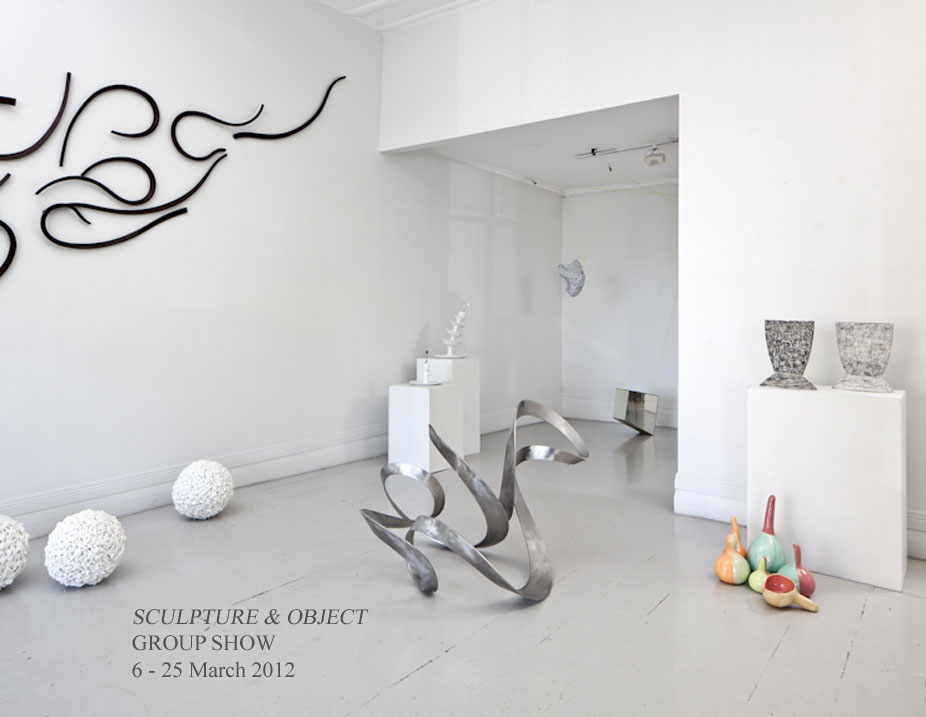
Sculpture & Object at Sanderson Gallery had a wonderful opening on Tuesday.  It's a gorgeous, coherent exhibition across a really diverse range of three dimensional art in many media. Ceramics, textiles, metal, paper and other materials all shared a sense of the makers touch and care in more-often-than-not quirky (and even humorous) pieces.

This is the second of five exhibitions I'm in over the next four months (the list is in the right column of the blog), the consequence of writing many proposals over the past six months.  I worked out the statistics this morning: I'm preparing and sending out an average of 1.6 proposals/applications/entries/submissions a month, with about a 50% success rate so far.

Momentum is building as I get more practised and confident at this side of the art business. The first proposal of this blitz took about a year of anguished procrastination, several weeks of drafting, interminable hours of assembling all the attachments and a firm push from a supportive friend.  The one I sent yesterday took me a few days of thinking, writing and sketching followed by an hour or so to put everything together.  It helps that my CV is up to date, the 'recent work' photos are assembled and suitably sized and my statements are honed.

I'm learning so much from this process as I cycle through it month after month.  I've noticed that my successful proposals are for situations which are a very good fit to the work I am doing right now.  So far most of the unsuccessfuls involved some stretching and bending for me or my work to meet the criteria.  I'm ambivalent enough about those to shrug off rejection with hardly a twinge of disappointment and a genuine interest in learning how to improve my chances as I pursue more passionately-desired goals in the future.

Each application involves reaching towards a situation which I aspire to and so I've started thinking of my proposals as bridges, my preparations as bridge building. The wider the gap between where I am now and the situation I'm applying for, the more carefully I need to build a sturdy, well-designed and sound structure to carry me towards my destination.


On Wairere Falls Track


Thursday, March 01, 2012

Icebergs in Auckland and Upper Hutt

I have Antarctica-themed work appearing in two group shows opening in March, one in Auckland and one in Upper Hutt (Wellington Region).  I'm really pleased because I so want Imagining Antarctica to have a wider audience beyond Hamilton. One of the nice consequences of my burst of productivity in 2011 is now I have an existing body of work to offer for group shows while I work towards upcoming solo shows and installations.

My Antarctica (Ross Island) Collection of Waikato Museum

Opening tonight at Expressions in Upper Hutt is a show called 'Common Threads' featuring contemporary artists who use woollen blankets in their practice.  The gallery has arranged to loan My Antarctica (Ross Island) from Waikato Museum's collection and I have sent down a couple of small icebergs.  This is a show I really wish I could see as I'm interested in so many of the artists. There's a floor talk on Sunday 29 April which would be fascinating. And the opening tonight features Words in Motion with poetry, story telling and music. I wonder if poet Apirana Taylor will recognise my name and remember knowing me as a little girl when he was a young poet published by my father?

Sanderson Gallery's Sculpture and Object group show 'brings together contemporary three-dimensional works from a selection of artists. Works include sculpture, installations, objects and ceramics.'  Other artists include Matt Moriarty and John Oxborough so I'm honoured to be in this company (and even more honoured that my Arch Berg is featured on the exhibition's front webpage).

Big Berg

I've sent up the  Big Berg and a number of smaller bergs from my Imagining Antarctica series. I'm going up to Auckland to attend the opening on Tuesday night, and I hope some of my Auckland friends will be there. (Opening starts at 5.30, please do come!).  I'm looking forward not only to the opening, but also to spending a weekday in central Auckland visiting galleries I haven't been to for a while.

I'll also be having a closer look at the Outeredge project window at Sanderson Gallery, where I will  install Dispersant next month.  So far I have stitched 358 globules, tea dyed 300 and starched 275. So I have a busy month to get all 400 finished and ready to hang by Easter's end.  You can be sure that I have a crochet hook and ball of cotton handy everywhere I go. If you see me in Auckland, ask and I'll show you my workbag!

Some starched globules waiting to have the wool stuffing picked out of them


Monday, February 20, 2012

What I actually do


Big oil spill in progress

 I've got three substantial works in progress at the moment and flit between them according to where I am, how hot it is or whether my fingers are getting tired of felting needle, stitching needle or crochet hook.  The making is of course in addition to working on a few proposals and applications and negotiating to consign existing works to out of town galleries.  2012 is turning out a busy and exciting year!

The needle-felted top of Te Aroha (935m)

I've finally pushed out my Tui Mine piece from the shores of planning and preparation onto the wide sea of making.  Starting at the top of Te Aroha, thick pads of New Zealand bush greens are being felted onto the contour lines above the mine.  I'm still waiting for embroidery threads to arrive in the post before I start stitching and can get a sense of what these mottled colours will ultimately look like. Hopefully less like camouflage fabric than they look right now!

My whole floor area covered in blankets and pattern pieces to be cut out for the big oil spill

Meanwhile, my urge to stitch is more than being satisfied with long waves of big black oil spill.  All the pieces of blanket are cut out, and as I felt, then stitch them around the edges of this very large work, it becomes more and more awkward to manage. Rolled up in its dust sheet I think of it as a baby whale, soft, heavy and compact.  But there is no longer anywhere big enough in my life to spread it out to see in full or pin the newest piece flat.  I have to work in sections with the rest of it folded or piled out of the way.  Despite this limitation I can tell it's looking good, well past its unlovable adolescence and into a big bold strong maturity.

Dispersant: colour check 
Last, but not least, are my globules of Dispersant. The count is now about 325 and there seems a good chance I will make it to my goal of 400 by the deadline (it didn't look so possible a month ago, but I've been working hard at it).  I recently took some time out from crocheting to choose a colour to paint the backdrop to the installation, one of my favourite shades of blue, a deep, cool under-water-column for me to fill with my tea dyed globules.

Friday, February 10, 2012

Fired up about Stockton Mine and Denniston Plateau

Stockton Mine (photo from Solid Energy)
I spend a lot of time looking at pictures of open cast mines (photographs, diagrams and maps) trying to make sense of the distorted landscapes; trying to understand what is up or down, to grasp the massive scale and identify different activities and elements.  I spend a lot of time trying to think how to respond to, interpret or represent open cast mining in my work.  I have mostly been frustrated and disappointed with my attempts to bridge the gap between my ideas and what my hands can produce.

It does seem as though my lack of first hand experience is an impediment, and that in this area at least, my imagination alone is inadequate for the task I set it. I have visited one open cast bauxite mine, at Weipa in Queensland Australia, but that was before I knew to look for what I would now.  That visit was certainly seminal in making mining such a priority for me, but the tour bus had filthy, heavily scratched windows, and my memory (and few photographs) are similarly hazy.

My best photo of Weipa's bauxite mine, taken through scratched and dirty bus windows. Bauxite sits on top of the earth at Weipa, they just scrape off 10m or so and then 'landscape' the much lower ground behind them.

Last night I went along to a talk about plans to mine Denniston Plateau in the South Island of New Zealand.  Over recent months I have read all I can, focused in on Google Earth from every angle, sought out every image of  Denniston and its sister Stockton Plateau where open cast mining has been underway for many years. My poor brain has felt as dull and dim as the Weipa bus windows in trying to visualise Denniston and Stockton.  But listening to Kevin Hackwell of Forest and Bird speak, while seeing his beautiful slides projected large and clear, was like knocking that opaque window out of the frame and seeing through clear air at last.

Finally, I can make sense of the geology of the Plateaus- tipped and cracked into different angles as they are, they still share the relatively shallow but very hard sandstone cap on top of high grade coal.  I could see with my own eyes the 80m tip of Mt Augustus being bulldozed into rubble and tipped down into the fertile, wild valley below. I could see the boundaries of the conservation land that includes the Plateaus.

I was completely engaged through the early part of the presentation, utterly entranced by the unusual ecosystem that clings to the exposed rocky top of the plateaus; the snails, the birds, the crayfish all intriguing.  Then the first slide showing Stockton's open cast operation flashed up and I felt a thrill through my body that seemed at odds with the groans of dismay uttered by the grey-haired greenies that filled the audience around me.    For me though, seeing the mining so clearly, and so well contextualised, was utterly compelling, fascinating and exciting as well as horrifying.  Finally I could make sense of the light and shadow, the shades of rock, the textures of each layer as the overburden is scraped away to reveal the thick rich black seam below.

Kevin had extraordinary stories to flesh out the images before us. The tenuous consent to mine nearby Happy Valley was granted at the last minute based on Solid Energy's spontaneous offer to roll up the wetlands and store them for a few years, then reinstate once all the coal had been removed(!). A case has been taken by investors in the Australian Stock Exchange against Bathurst for misinformation in their prospectus for mining Denniston.  Bizarre and possibly futile efforts to relocate the unique carnivorous snail from Mt Augustus before it was decapitated.  The mysterious jewel-like flatworm, unknown to science, found by contractors during the snail removal, whose photograph has been suppressed by Solid Energy.  Our new government reversing its promise to publicly notify the access agreement that allows Bathurst to mine on Conservation land, just two days after last years election.

Biking home after the talk, under the moon rising golden and swollen in a halo of little clouds, my mind was full of the stories and images of Denniston and Stockton. What had been a nagging ache of desire to visit there was simultaneously sated and inflamed.  I am full of ideas and eager to begin making confident at last that I know what to do, but it also seems even more urgent to find a way to fund a field trip to see for myself.  The urgency is not just to feed my creative hunger, but also because this year is the turning point for Denniston. Consent has been granted, but will be appealed to the Environment Court (and possibly beyond) this winter. If the appeals lose all the way, mining could begin on Denniston next summer.  It is a crucial time for public activism and thus raising public awareness. If my planned textile works can help raise public awareness to positive effect, then I want them not to be too late.