Showing posts with label archaeology. Show all posts

Tuesday, November 24, 2009

Winning Gifts

Hooray, we have a winner for the November giveaway and it's only a few days late this month! Aneta's name was the one pulled out of the freshly washed cottage cheese container yesterday. Aneta found my blog after hearing me speak at her department's professional development day last Friday.

I talked about following and fulfilling your dreams and integrating their essence into your daily life. Even though I had to present for 45 minutes on a moving bus, I didn't get motion sickness and everyone seemed pretty happy with my offerings. Thanks Aneta for taking the time to let me know you enjoyed my talk, and congratulations on winning a couple of tiny experimental books.

Tiny book

Some of you have been wondering if I'm going to sell the embossed fossils I've been making so prolifically. The main project is towards an exhibition next winter, but I decided they were too lovely keep only behind glass. I've printed an open edition onto a thick creamy stock and packaged them up in a handmade faux museum portfolio with a poem I've written called Punctuated Equilibrium.

Although in reality you can just click through to the Bibliophilia Etsy store and make a swift and sanitary purchase, followed promptly by delivery to your mailbox; I have imagined an alternative scenario while making this edition...

You are riding a bus between distant cities, and when it stops for 15 minutes in a tiny country town you disembark gratefully, gulp down an icy drink and then wander nextdoor to a dim and dusty secondhand store. Rummaging in a bin of old leaflets you find a manilla porfolio. Through the foxing on its typewritten label you read 'Five Fossils' and intrigued, you unwrap the red thread closure. Inside are an ammonite, star fish, sea urchin, trilobite and Ediacaran jellyfish. You finger the dry and delicate texture of the paper fossils, and then realise there is a coffee-stained typed page tucked behind them. But outside you hear the rumble of the bus engine starting, there's no time to read the text. The old man muttering to himself behind the cluttered counter sells you the portfolio and you scramble back on the bus feeling that you've just scored a mysterious bargain that will transform the rest of your dull coach trip.

Monday, July 13, 2009

Life on Mars

Three pins in a row

I'm balancing my attention, my research and my stitching between two forces of evolutionary change. On the one hand I cherish the poignancy of fossils, with their stories of climate change and extinction. On the other hand, I am drawn to stories of the resilience and persistence of life in the harshest of environments.

Crinoid- Sea Lily

Launching into my second fossil embroidery, I wondered why I was so determined to give some mossy background to my Paleozoic sea lily. At first I thought it was a simple desire for some colour to brighten up my drab stony scheme, but after a while I realised it was a longing for life itself.

Mossy fossil stem

My stitched fossils are telling stories of evolution and extinctions caused by climate change whether caused by meteor strikes, the long cycles of Earth moving closer to and further from the sun, or human behaviours. I'm intrigued by the theory that in the past, bursts of evolutionary change have been triggered by major climate change clearing ecosystems with mass extinctions.


I decided to channel my longing for life into some small stitched works and see where they led me. And the first place they've taken me is Mars. I've made a set of three embroidered pins as tiny Mars gardens, inspired by Kim Stanley Robinson's trilogy of novels of Mars colonisation. I've long been fascinated by his alternative narrative of climate change to support new life, rather than causing inadvertent extinction.

In Green Mars, he describes in loving detail the emergence of plant life in Mars' harsh environment, still freezing and toxic even after 60 or so years of deliberate climate change to warm and oxygenate the atmosphere. Huge floods caused by warming and drilling have covered swathes of Mars in ice and fellfield gardens are growing around the glaciers.

Much of the regolith on Mars had been superarid, so arid that when water touched it there were powerful chemical reactions- lots of hydrogen peroxide release, and salt crystallisations- in essence the ground disintegrated, flowing away in sandy muds that only set downstream... in frosty new proto-fellfields.... those rocky swathes that were the first living communities after ice receded, their living component made of algae and lichens and moss. (p131)

As he hiked through the frigid air he spotted many different species of snow algae and lichen. The glacier-facing slopes of the two lateral ridges were especially well populated, flecked by small patches of green, gold, olive, black, rust, and many other colors- perhaps thirty or forty all told. Sax strolled over these pseudo moraines carefully, as unwilling to step on plant life as he would be to step on any experiment in the lab. Although truthfully it looked as though most of the lichens would not notice. They were tough, bare rock and water were all they required, plus light- though not much of that appeared necessary- they grew under ice, inside ice, and even inside porous chunks of translucent rock. In something as hospitable as a crack in the moraine they positively flourished. Every crack Sax looked in sported knobs of Iceland lichen, yellow and bronze, which under the glass revealed tiny forking stalks, fringed by spines. On flat rocks he found crustose lichens: button lichen, stud lichen, shield lichen, candlelaria, apple-green map lichen and the red-orange jewel lichen that indicated a concentration of sodium nitrate in the regolith. Clumped under the ice flowers were growths of pale gray-green snow lichen, which under magnification proved to have stalks like Iceland lichen. (p172)


All three Mars Garden pins are for sale on Etsy, but if you are uncomfortable with internet shopping or USdollars, please contact me directly.
By the way, don't forget to enter the draw for a stitched coral brooch. Comment here to be in to win!

Friday, June 26, 2009

First Fossils

Spontaneous stitches.

With the coral-making safely behind me (or rather steaming ahead as semi-finalist in the National Contemporary Art Awards - woot!), stitching fossils is my latest consuming passion.

I've been thinking about this for many months but didn't let myself start until You are an agent of change was all finished. Somehow I knew that once I got a taste for this fossil work I wouldn't be able to tear myself away from it to pay proper attention to anything else. My test piece was a tessarolax fittoni, an extinct gastrapod from the Cretaceous era (145-65 million years ago).

Two fossil images

I stitched it onto a piece of an old blanket that I found in an op shop, already felted probably by hot washing at some point. It's a lovely fabric to work with. The tessarolax is stitched next to the blanket label, which though worn to shreds, says "Kaiapoi Woolen Mfg Gompany Christchurch New Zealand (All Pure NZ Wool)". The Kaiapoi Woolen Company closed in 1978 after a century in business. It was the beginning of the end of an era in which New Zealand companies manufactured most of our needs and few goods were imported from overseas. Two fossils then, together on one blanket, representing extinct species of a past ecology.

Kaiapoi Woolen Company Mills, Kaiapoi (a small town I've visited a few times: Hi Sharkey!)

The next square of Kaiapoi blanket is being stitched with a crinoid, a sea lily enchinoderm, from the Mississipian period (362-323 million years ago) of the Paleozoic era. Now that I'm confident about working on the felted blanket, I feel inclined to be more adventurous with texture and colour. It's all done free hand, as I'm basically making it up as I go along, with reference to my sketches from photos in fossil books. Stitching the coral felt like drawing with thread, and this feels like painting only much much slower; at the glacial pace that I like to work and that so suits this subject matter.

Some species of sea lillies aka crinoids still exist, though in nothing like the numbers of the distant past when this forbesioncrinus meeki flourished on the sea floor of what is now Indiana, USA. Despite the name they are animals, related to sea stars.

Monday, September 25, 2006

Dinasaurs


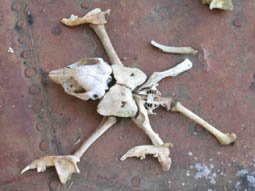
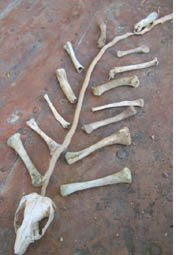
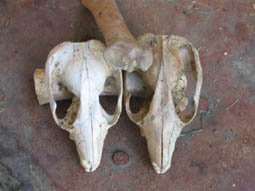
I was visiting a family this weekend where, Rory, about 8 years old, turned out to have an even more extensive collection of possum bones than I do (I keep using mine in projects and having to collect more). We made up a few skeletons together on the old copper covered rudder of the sugar barge they live in.

Wednesday, July 26, 2006

Parihaka Poem

I would have posted this poem earlier but I had it entered in a competition. Since it didn't place there, here it is for your delectation.

High above Whangarei

the mountain tells a story

of a settlement overgrown

by nikau and ferns,

a story elusive as dreams are

after a new day has begun.

Where only birds

hunt and sleep and sing today,

hundreds of people long ago lived inside

village palisades spiking every ridge line.

Huge pits, now shallowed by generations of leaves,

were filled with kumara grown

in the rich alluvial valley below.

Cold mossy stone squares

mark hearths that glowed with warmth and light,

at the centre of hapu storytelling.

Their mokopuna’s mokopuna

tell stories in other whare now,

still remembering battles on the mountain.

The slick white clay tangata whenua

carved into pits and terraces

was built up over millennia

by the bodies of ancient kauri

transformed with infinite slowness

into a substance so dense

that the earthworks stay true

centuries after the final fleeting

generations were driven out by muskets.

Thus the earth also holds their memory

in the shape of the land

still beneath young trees

as the mountain returns to itself

from a dream of human habitation.

Monday, July 03, 2006

Matariki up the Mountain

Another Matariki event I attended was a guided tour of the pa sites on Parihaka with an archaeologist and kaumatua (Maori elders). I had negotiate some time off work, because it was scheduled on a Tuesday morning (the actual day of Matariki) so I drove to the Summit carpark (the first time I hadn't walked up Parihaka and it felt like a terrible cheat).

The twenty or thirty manahiri (guests) were welcomed onto the Summit with a powhiri. Our group was included a some young pakeha mothers with their preschool children, a uniformed group of teenagers from a Wharekura (Maori language high school) and assorted adults of various ages and ethnicities. I was particularly appreciative of the teenagers who confidently sang waiata that I'd never heard before in beautiful harmonies. (If you don't already know, a powhiri involves -among other things- a series of speeches and prayers in te reo Maori from hosts and guests, and each speaker is followed by a song led by someone in his -and it's almost always his- party. When the group is mostly pakeha, the waiata part can be pretty shameful).

After the powhiri one of the kaumatua, Te Ihi, talked for a long time on the viewing platform, from which you can look out across the harbour and town of Whangarei and beyond to the old volcanoes pimpling the land all the way to the horizon. He told us about the battle to have the official name of the mountain corrected to the original, finally achieved last year. He talked about the some of the landmarks, the meaning of their Maori names and a few stories, but he didn't really tell us much about Parihaka itself.

That was left to James Robinson, the archaeologist, who turned out to be neither a fusty old academic nor Indiana Jones (that would have been good) but an incredibly well prepared, articulate, passionate, knowledgeable and unpretentious guy about not much older than me. He directed much of his spiel at the teens, referring to the pa-dwellers as 'your tupuna' (ancestors) which won them over completely. When the preschoolers started to lag behind the group, he just picked one up and carried on talking with a toddler on his hip for the rest of the tour.

I have spent quite a few hours wandering the tracks and pa site trying to imagine the mountain when it was home to hundreds of people. My imagination and ability to see the evidence were completely inadequate compared what James showed us. A flat terrace off the track not far from the summit had never even caught my eye. Turns out, like almost every surface on the mountain it had been altered by human hands at some point. Literally by hand, the terrace (big enough to build a single garage) had been carved out of the hillside using digging sticks. Same with the enormous kumara pits used for storing enough vegetables for a chief to throw a huge feast.

Parihaka is an exceptionally well preserved pa site. Although all the roofs and walls and tools have long since disappeared, all the earthworks have held their shape very well for 200 years or more. This is because of the unusual white clay that covers much of the mountain. It was formed by kauri forests over thousands (millions?) of years: as the litter of the hard wood broke slowly down it became incredibly dense clay. The denseness of the clay posed engineering challenges for the kumara pit diggers: they needed to ensure excellent drainage so their food stores wouldn't rot in the rainy climate. Their drains and sumps can still be found under the fallen leaves that have filled in the pits by at least a metre since they were abandoned.

There were no stones up the mountain before people came there. Thus any rocks to be found are 'cultural', brought there by someone for some purpose. The most obvious are the several hearths that are still intact on the sites of old houses. I look at them and try to imagine the task of carrying those rocks up the long steep muddy track from the river, barefoot.

The archaeological evidence suggests that Parihaka was home to hundreds of people for hundreds of years but probably not permanently inhabited by great numbers at a time, except when the wider community was under attack or coming together for rituals or celebrations. Significant defenses meant that stored food was safe from raiders and people who usually lived closer to their gardens or fishing places could retreat to a stronghold. Today deep ditches and sheer cliff faces remain to show the boundaries of the pa that originally were reinforced by tall spikey palisades. In an era of hand weapons, height gave a fourfold advantage to the defenders. However, in the 1820s, the 'Musket Wars' removed that advantage and Parihaka was abandoned as people moved south and inland seeking safety (or revenge). Not long after that European surveyors were carving up the mountain and surrounds for Pakeha ownership (it was during this period that the misnomer of Parahaki became entrenched). Fortunately the four men who owned the west facing slopes all chose to set aside the land as reserve and that is why today, in the middle of Whangarei, there is such a wonderful park of native bush and historical significance.