Saturday, March 31, 2012

Lovely for me

A strand of Dispersant, casting night shadows on the studio wall

In preparation for installing Dispersant in the Outeredge Project window in just a couple of weeks I am attaching my 400 crocheted, dyed and starched globules to fishing lines. I keep coming up short whenever I run out of the strips of old sheet and duvet cover that I use to carefully wrap each strand so they don't tangle in their boxes (five big boxes full so far).  So sometimes a strand of globules is left hanging in my studio for a day or two.  At night my bedside lamp is well positioned to cast lovely shadows through the globs. It is incredibly beautiful and I'm afraid I am the only person who will ever see them looking like this.

I feel sorry for (most) people who only get to see my finished art works in galleries because there are so very many moments of loveliness in the making and you will never know them as I do. I try and share as many work in progress (wip) photos here as I can, and often I continue to use wip photos after the piece is complete, because they remain my favourite images. But if I stopped and took a picture every time I noticed the transient loveliness under my hands I fear I would be even slower than the outrageously slow artist that I am anyway.  So most of my delight unfolds hour after hour in exclusive solitude.

Much of the loveliness can't be captured in photos, and I'm sorry, not matter how I try, my words are inadequate. How can I share with you the feeling of pulling floss through plump felted layers of blanket? The shushing of cotton and wool fibres stroking past each other until I sense just the right tension has been reached, the stitch is complete and the smooth point of the needle probes into the dense softness to begin the next stitch.  Over and over and over again, in a rhythm governed by the ever shortening length of thread, which begins as long as my arm can stretch from my lap and ends as short as the needle.  The trance is broken, I stitch the knot, snip the ends, pull another three strands of DMC off the card and thread the needle.

That's the pause when I am most likely to look beyond the row I am stitching to see the whole of what I've made so far.  Sometimes, especially in the long middle of a big project it's not lovely at all.  There's an awkward adolescence in which the charms of beginning are exhausted and the satisfaction of maturity seems a long way off. But I love the first stages of all my pieces as fiercely as a mother loves her newborn baby.  And coming to the end, seeing my vision made manifest the pieces look as intensely gorgeous to me as they ever will. More than the finished piece will, because once its finished I am stuck with all the little flaws and disappointments I have settled for.  No more potential, and to me, potential where the real beauty lies.

Monday, March 26, 2012

Blizzard Wins an Award

Blizzard (2011)
I won an award!  One of the four 2012 National Contemporary Fibre Arts Awards, the one sponsored by the Nelson City Council for 'the work which best embraces the theme of 'Water and/or Light'  The winning work is Blizzard, part of my Antarctica series.

The judges "felt that there was a lovely subtlety in the work, and that we loved the feeling of disappearing into the blizzard which the depth of the work gave.We also liked the contemporary interpretation of the quote, and the choice of fabric."

I am deeply moved by this Award.  I got a bit hysterical when I first found out, laughing uncontrollably as I conquered my surprise to let the news sink in. Then I started to cry a little. And then, because I had a busy day planned I had to just get on with what I had to do.  But every time I remember this exciting news I roll through another emotional response.   Here are three reasons why it is affecting me so deeply.

I've been a selected finalist in national art awards four times in the past four years but this is my first win.  It feels like an overwhelming acknowledgement of the persistent hard work I put into my art practice, and my commitment to pursuing new directions.  I'm very glad Blizzard is getting this recognition because it is a little different from the work I'm best known for, so I feel the Award is encouraging me to keep experimenting technically as I dig deeper conceptually.

Blizzard (detail)
I almost didn't enter Blizzard because I didn't know how I was going to pay for the courier fee.  Nelson is on  another island, and Blizzard is a big work, not heavy but a large awkward parcel that was expensive to send.   Unexpected dental costs a few months ago used up all my savings and put me on a back foot money-wise.  I sent up a prayer to the universe to sort my finances out before the credit card bill came due and sent the work to Nelson anyway.  The Award is a cash prize of $1500 which will cover all my current bills and make a huge difference over the next few months.  Thank you universe!

Last but not least, is the timing of this award for Blizzard. A century ago this month Captain Laurence 'Titus' Oates died in an Antarctic blizzard. His final words 'I'm just going outside and may be some time' is one of the most famous Antarctic quotes and I made it into Blizzard.  It sends shivers down my spine to have my own honour coincide with this anniversary. There are many celebrations and memorials taking place for Scott's Polar Party this year, and I feel that this Award gives me another connection with Oates and his companions.

The Awards show is called Changing Threads and is on at The Refinery Artspace in Nelson, New Zealand until 21 April.  Unfortunately I won't get a chance to go down and see it, but if you do, please write and tell me all about it.

Wednesday, March 14, 2012

400 Globules

One strand


This morning I finished crocheting the 400th globule for the Dispersant installation.  I think I started the first globule back in September when I was still thinking of them as spheres
Looking up
  for clouds.  It's been a long journey and its not quite finished yet.


Each of the crocheted globules is dyed in tea, then starched in home made wheat starch with a wool stuffing so they hold their sphere-ish shape as they dry. Then the wool stuffing is picked out and finally the globules are tied to fishing lines, ready to hang in the Outeredge Project window next month.Whew!

All together it works out to about 50 minute per globule from start to finish which that adds up to about 333 hours in total of making for this project.  Not quite as long as making My Antarctica, and definitely easier because of the modular aspect of it, but on a similar scale.

I had my first real crack at attaching the globules to their fishing lines this week.  I really like how they look, and can't wait to see them en masse, against the dark blue background.

I'm pleased to have finished the crocheting, especially because at one stage I'd fallen behind my production schedule and was worried I wouldn't get them all made in time. But as usual for me, its a bitter sweet sense of satisfaction because I always enjoy the process of making so much and now that fun part is over.

I'm not sure what I can do next as a portable project to occupy my hands when I'm on the bus, or visiting friends.  Without a little project in my bag I am prone to anxiety and impatience.

Shall I indulge in something purely personal as a break from my gallery oriented projects?  Helen Lehndorf's cute knitted necklace reminded me that I was keen to make a crocheted necklace last year but got caught up in making my globules instead.  
It has to be a very quick project because I am just *this* far away from deciding what my next modular making gallery project will be. Well actually I pretty much know, I just haven't decided yet how urgent it is. So I better hurry out to my storage unit and have a sort through my little stash of wool yarns.
A batch of starch ready to be rubbed into the globules

Thursday, March 08, 2012

Writing Bridges

Click on image to see more of the show
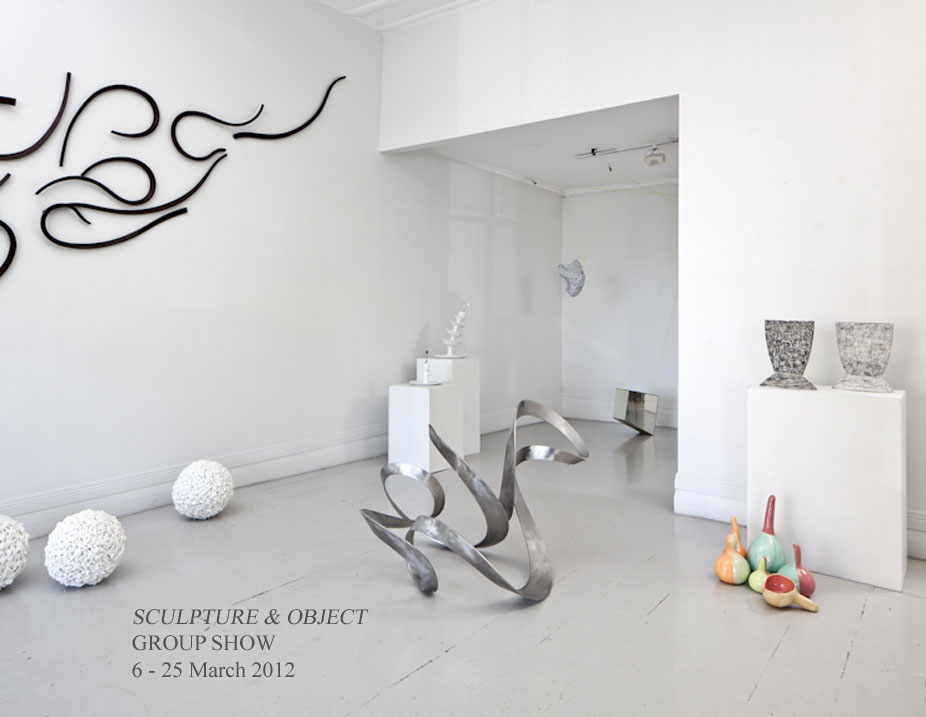
Sculpture & Object at Sanderson Gallery had a wonderful opening on Tuesday.  It's a gorgeous, coherent exhibition across a really diverse range of three dimensional art in many media. Ceramics, textiles, metal, paper and other materials all shared a sense of the makers touch and care in more-often-than-not quirky (and even humorous) pieces.

This is the second of five exhibitions I'm in over the next four months (the list is in the right column of the blog), the consequence of writing many proposals over the past six months.  I worked out the statistics this morning: I'm preparing and sending out an average of 1.6 proposals/applications/entries/submissions a month, with about a 50% success rate so far.

Momentum is building as I get more practised and confident at this side of the art business. The first proposal of this blitz took about a year of anguished procrastination, several weeks of drafting, interminable hours of assembling all the attachments and a firm push from a supportive friend.  The one I sent yesterday took me a few days of thinking, writing and sketching followed by an hour or so to put everything together.  It helps that my CV is up to date, the 'recent work' photos are assembled and suitably sized and my statements are honed.

I'm learning so much from this process as I cycle through it month after month.  I've noticed that my successful proposals are for situations which are a very good fit to the work I am doing right now.  So far most of the unsuccessfuls involved some stretching and bending for me or my work to meet the criteria.  I'm ambivalent enough about those to shrug off rejection with hardly a twinge of disappointment and a genuine interest in learning how to improve my chances as I pursue more passionately-desired goals in the future.

Each application involves reaching towards a situation which I aspire to and so I've started thinking of my proposals as bridges, my preparations as bridge building. The wider the gap between where I am now and the situation I'm applying for, the more carefully I need to build a sturdy, well-designed and sound structure to carry me towards my destination.


On Wairere Falls Track


Thursday, March 01, 2012

Icebergs in Auckland and Upper Hutt

I have Antarctica-themed work appearing in two group shows opening in March, one in Auckland and one in Upper Hutt (Wellington Region).  I'm really pleased because I so want Imagining Antarctica to have a wider audience beyond Hamilton. One of the nice consequences of my burst of productivity in 2011 is now I have an existing body of work to offer for group shows while I work towards upcoming solo shows and installations.

My Antarctica (Ross Island) Collection of Waikato Museum

Opening tonight at Expressions in Upper Hutt is a show called 'Common Threads' featuring contemporary artists who use woollen blankets in their practice.  The gallery has arranged to loan My Antarctica (Ross Island) from Waikato Museum's collection and I have sent down a couple of small icebergs.  This is a show I really wish I could see as I'm interested in so many of the artists. There's a floor talk on Sunday 29 April which would be fascinating. And the opening tonight features Words in Motion with poetry, story telling and music. I wonder if poet Apirana Taylor will recognise my name and remember knowing me as a little girl when he was a young poet published by my father?

Sanderson Gallery's Sculpture and Object group show 'brings together contemporary three-dimensional works from a selection of artists. Works include sculpture, installations, objects and ceramics.'  Other artists include Matt Moriarty and John Oxborough so I'm honoured to be in this company (and even more honoured that my Arch Berg is featured on the exhibition's front webpage).

Big Berg

I've sent up the  Big Berg and a number of smaller bergs from my Imagining Antarctica series. I'm going up to Auckland to attend the opening on Tuesday night, and I hope some of my Auckland friends will be there. (Opening starts at 5.30, please do come!).  I'm looking forward not only to the opening, but also to spending a weekday in central Auckland visiting galleries I haven't been to for a while.

I'll also be having a closer look at the Outeredge project window at Sanderson Gallery, where I will  install Dispersant next month.  So far I have stitched 358 globules, tea dyed 300 and starched 275. So I have a busy month to get all 400 finished and ready to hang by Easter's end.  You can be sure that I have a crochet hook and ball of cotton handy everywhere I go. If you see me in Auckland, ask and I'll show you my workbag!

Some starched globules waiting to have the wool stuffing picked out of them


Monday, February 20, 2012

What I actually do


Big oil spill in progress

 I've got three substantial works in progress at the moment and flit between them according to where I am, how hot it is or whether my fingers are getting tired of felting needle, stitching needle or crochet hook.  The making is of course in addition to working on a few proposals and applications and negotiating to consign existing works to out of town galleries.  2012 is turning out a busy and exciting year!

The needle-felted top of Te Aroha (935m)

I've finally pushed out my Tui Mine piece from the shores of planning and preparation onto the wide sea of making.  Starting at the top of Te Aroha, thick pads of New Zealand bush greens are being felted onto the contour lines above the mine.  I'm still waiting for embroidery threads to arrive in the post before I start stitching and can get a sense of what these mottled colours will ultimately look like. Hopefully less like camouflage fabric than they look right now!

My whole floor area covered in blankets and pattern pieces to be cut out for the big oil spill

Meanwhile, my urge to stitch is more than being satisfied with long waves of big black oil spill.  All the pieces of blanket are cut out, and as I felt, then stitch them around the edges of this very large work, it becomes more and more awkward to manage. Rolled up in its dust sheet I think of it as a baby whale, soft, heavy and compact.  But there is no longer anywhere big enough in my life to spread it out to see in full or pin the newest piece flat.  I have to work in sections with the rest of it folded or piled out of the way.  Despite this limitation I can tell it's looking good, well past its unlovable adolescence and into a big bold strong maturity.

Dispersant: colour check 
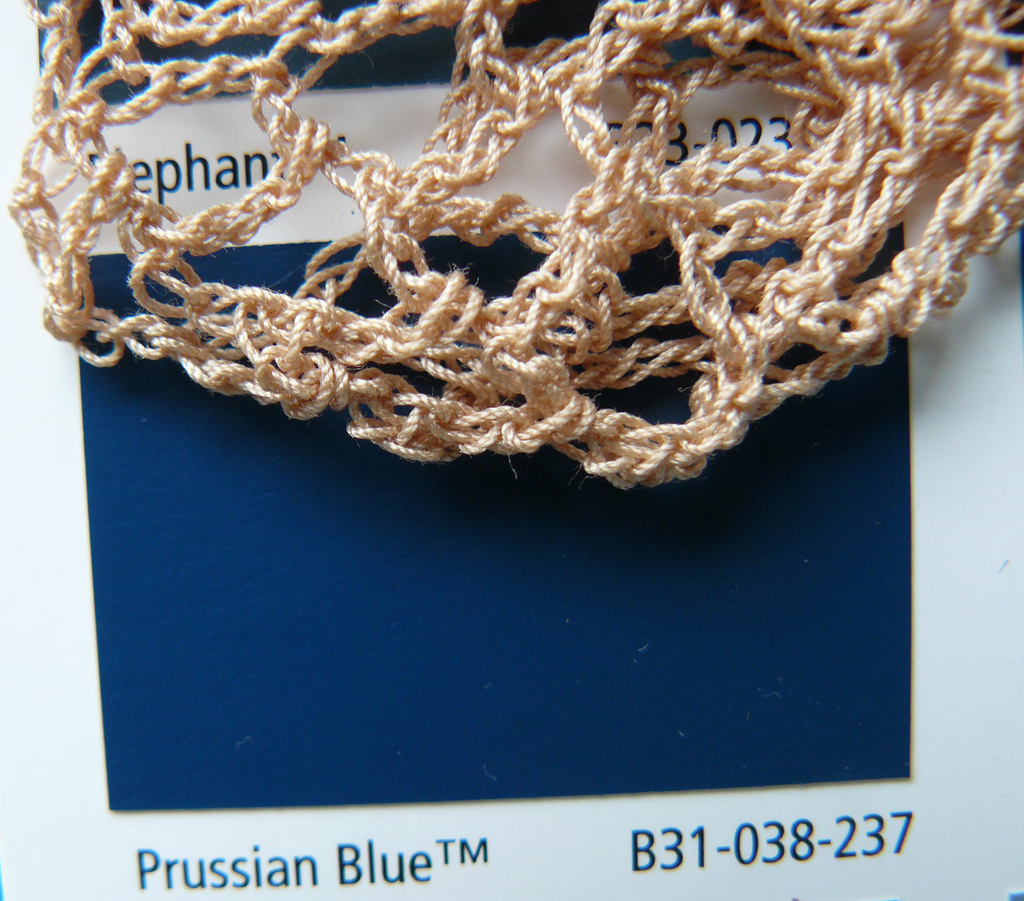
Last, but not least, are my globules of Dispersant. The count is now about 325 and there seems a good chance I will make it to my goal of 400 by the deadline (it didn't look so possible a month ago, but I've been working hard at it).  I recently took some time out from crocheting to choose a colour to paint the backdrop to the installation, one of my favourite shades of blue, a deep, cool under-water-column for me to fill with my tea dyed globules.

Friday, February 10, 2012

Fired up about Stockton Mine and Denniston Plateau

Stockton Mine (photo from Solid Energy)
I spend a lot of time looking at pictures of open cast mines (photographs, diagrams and maps) trying to make sense of the distorted landscapes; trying to understand what is up or down, to grasp the massive scale and identify different activities and elements.  I spend a lot of time trying to think how to respond to, interpret or represent open cast mining in my work.  I have mostly been frustrated and disappointed with my attempts to bridge the gap between my ideas and what my hands can produce.

It does seem as though my lack of first hand experience is an impediment, and that in this area at least, my imagination alone is inadequate for the task I set it. I have visited one open cast bauxite mine, at Weipa in Queensland Australia, but that was before I knew to look for what I would now.  That visit was certainly seminal in making mining such a priority for me, but the tour bus had filthy, heavily scratched windows, and my memory (and few photographs) are similarly hazy.

My best photo of Weipa's bauxite mine, taken through scratched and dirty bus windows. Bauxite sits on top of the earth at Weipa, they just scrape off 10m or so and then 'landscape' the much lower ground behind them.

Last night I went along to a talk about plans to mine Denniston Plateau in the South Island of New Zealand.  Over recent months I have read all I can, focused in on Google Earth from every angle, sought out every image of  Denniston and its sister Stockton Plateau where open cast mining has been underway for many years. My poor brain has felt as dull and dim as the Weipa bus windows in trying to visualise Denniston and Stockton.  But listening to Kevin Hackwell of Forest and Bird speak, while seeing his beautiful slides projected large and clear, was like knocking that opaque window out of the frame and seeing through clear air at last.

Finally, I can make sense of the geology of the Plateaus- tipped and cracked into different angles as they are, they still share the relatively shallow but very hard sandstone cap on top of high grade coal.  I could see with my own eyes the 80m tip of Mt Augustus being bulldozed into rubble and tipped down into the fertile, wild valley below. I could see the boundaries of the conservation land that includes the Plateaus.

I was completely engaged through the early part of the presentation, utterly entranced by the unusual ecosystem that clings to the exposed rocky top of the plateaus; the snails, the birds, the crayfish all intriguing.  Then the first slide showing Stockton's open cast operation flashed up and I felt a thrill through my body that seemed at odds with the groans of dismay uttered by the grey-haired greenies that filled the audience around me.    For me though, seeing the mining so clearly, and so well contextualised, was utterly compelling, fascinating and exciting as well as horrifying.  Finally I could make sense of the light and shadow, the shades of rock, the textures of each layer as the overburden is scraped away to reveal the thick rich black seam below.

Kevin had extraordinary stories to flesh out the images before us. The tenuous consent to mine nearby Happy Valley was granted at the last minute based on Solid Energy's spontaneous offer to roll up the wetlands and store them for a few years, then reinstate once all the coal had been removed(!). A case has been taken by investors in the Australian Stock Exchange against Bathurst for misinformation in their prospectus for mining Denniston.  Bizarre and possibly futile efforts to relocate the unique carnivorous snail from Mt Augustus before it was decapitated.  The mysterious jewel-like flatworm, unknown to science, found by contractors during the snail removal, whose photograph has been suppressed by Solid Energy.  Our new government reversing its promise to publicly notify the access agreement that allows Bathurst to mine on Conservation land, just two days after last years election.

Biking home after the talk, under the moon rising golden and swollen in a halo of little clouds, my mind was full of the stories and images of Denniston and Stockton. What had been a nagging ache of desire to visit there was simultaneously sated and inflamed.  I am full of ideas and eager to begin making confident at last that I know what to do, but it also seems even more urgent to find a way to fund a field trip to see for myself.  The urgency is not just to feed my creative hunger, but also because this year is the turning point for Denniston. Consent has been granted, but will be appealed to the Environment Court (and possibly beyond) this winter. If the appeals lose all the way, mining could begin on Denniston next summer.  It is a crucial time for public activism and thus raising public awareness. If my planned textile works can help raise public awareness to positive effect, then I want them not to be too late.


Tuesday, February 07, 2012

A visit to the unit


The first action on visiting is always to move the spinning wheel and tapestry frame out into the hallway so I can access what I need. I share the rental on the storage unit with a friend who rarely needs to access his excess household possessions, so his bits are all at the back (top layer of mattresses visible). 
My studio flat is too small to contain me, all my possessions and all my home and studio activities. One of the ways I manage around this is by renting a storage unit about five minutes bike ride away.  Everything that is not in at least weekly use lives in the storage unit. I visit the unit once every week or two. I pick up and drop off what I can fit on my bicycle (or persuade someone with a car to help me, if there is too much bulk for my bike). I spend time there working too: packaging pieces to send to collectors or galleries; photographing work against the big bare walls of the corridor; and sometimes even doing the odd bit of stitching.
Note the green forks on the front of the bike which has lost its some of its glamour since the original forks had to be replaced in a hurry recently.
The list of things to do at the unit this weekend included packaging up a framed work to send to a collector. You can see it squeezed into the saddlebag on the back of my bike above.  I was also going through my fabric stash to choose fabric to sew a dust cover for my new sewing machine.  The vintage curtain fabric below is very funky and fun but also too ugly and weird for me to want to use in something decorative or sartorial. The yellow ground is printed with images of playing cards, smoking paraphernalia, coffee and booze.  I don't share any of those addictions, but making things is my addiction so I finally feel like I've found the right purpose for the cotton.

I learned how to use my new sewing machine on the dust cover project.

The most important task was to get into my Box o' Bergy Bits and prepare some for sending to an exhibition in Auckland next month, at Sanderson Gallery's new Paper/Project space.  The exhibition is called 'Object' (opening 6 March) and I am sending up four of my icebergs, including Big Berg.  When Big Berg was dis-installed from the Imagining Antarctica exhibition last year, someone cut short the fishing line used to suspend it. Since getting the fishing line into the Berg in the first place had been a long morning of tears, bad language and several broken needles, I've been postponing this repair task for months.  Now the time had come, but within the first five seconds, my only big needle broke.  It will have to wait a few more days while I re-equip.  (Lesson learned: provide dis-installation as well as installation instructions).

Iceberg resting on exhibition details
I finally got round to another long procrastinated task, to sew printed cotton labels onto the bases of the smaller bergs.  I've been frustrated with my previous labelling system for a long time until I came up with idea of getting labels printed on cotton that I can sew discreetly onto pieces. At least those pieces that have backsides or bottoms. It makes me cringe have my labels visible which was a problem with my old labelling system, as curators seemed to love to show them off and I would have to go around my exhibition trying to hide the labels, only to find them dragged out into view next time I visited.

What better to have on my label than the URL of my brand new gallery website ?

Friday, February 03, 2012

Brand Shiny New

I'm overjoyed to announce the launch of my new 'gallery' website at www.meliors.net.  It's been years in the dreaming, months in the planning and weeks in the making. The intention with my new site is to provide a reference point for collectors, curators and others to easily view  the best of my recent work, find biographical information and links to interviews and so on.

I find creating digital work very stressful compared to the slow sensual pleasures of hand crafting physical objects; so I can't praise too highly my website developer Conrad Johnston at Darnoc. Conrad's calm and competent approach helped me to overcome my angst and develop my own web skills as well as a new website.  He was particularly patient with my fussy intolerance of anything that didn't match my vision- even when my vision didn't match my (tiny) budget.

Bibliophilia will carry on being my blog right here on Blogger. The gallery website is a complement, not a replacement. However, the URL link, meliors.net that I've been using for this blog for several years, now will point visitors straight to the gallery website requiring another click through to the blog. If you are a frequent visitor, you might want to save meliors.blogspot.com to bring you directly to Bibliophilia for new content most weeks.  But  please do go have a look around at www.meliors.net first.

One of the joys of being an artist is getting to know the people who love my work enough to buy it, so I thought long and hard about how to enable people to buy my art via the website.  Rather than clicking through to a shopping cart, anyone interested in buying a piece just needs to send me a message. (More information is available on the website.)  That way you and I, both know we are dealing with a real human being.  It might not be quite as instant as shopping on Etsy or Amazon, but since whatever you are buying from me took weeks, if not months to make, an exchange of messages over a few minutes or hours seems an appropriate way to transfer its ownership.

Please share my new website with anyone you think would be interested in an overview of my recent work, and this blog with anyone interested in the unfolding process of its creation.

Friday, January 27, 2012

Close up of Tui Mine

View from the Tui Mine site, looking out over the town of Te Aroha and the Hauraki Plains
 As part of the research I'm doing for my next mining project I visited the site of the Tui Mine with some friends this week.  As it is the most toxic site in New Zealand and currently being remediated, there is no vehicle access, and many dire warnings about accessing it on foot.  So we didn't know how close we could get until we got there.  The walk up Te Aroha mountain was very steep, through some very beautiful native bush. There were a few birds about, but not many- which is not unusual for the middle of the day.  


Tunakohia  Stream, fed with water from inside the mines
We crossed several sparkling clear streams and rills, but despite the temptations of the beautiful water we tried to avoid contact with it, sharing our water bottles with Tara the dog so she wouldn't drink from the streams.  After heavy rains, or when the mine site is disturbed (as it must be during the remediation work), these streams can be full of toxic heavy metals (lead, cadium, mercury).   

Some rusty old mining rubbish lying around in the bush
 As we got higher up the mountainside and closer to the mine site, we started to hear the roar of heavy machinery and even a muffled explosion. The lower level of the large area of the mine is the tailings dam which is the current focus of remediation work.   I managed to get a peep at it through the trees, but could only see a small section of new tailings dam under construction. It will replace the crumbling old concrete dam left by the mining company when they flitted off leaving 90,000 tonnes of toxic tailings perched precariously on the steep mountainside above the little town of Te Aroha.

Constructing the new tailings dam
Higher and higher we climbed, and eventually came to one of the entrances to the underground mines of Tui. I thought recognised it from an old home video I watched at Te Aroha museum last months where a group of ex-miners revisit their old work place. This meant I could visualise the inside of the mine (dark, wet, dangerous, deep), even though the entrance is decisively blocked (not that I would venture inside a Tui Mine casually anyway).

Entrance to underground mine (top right).  Tunakohoia stream flows right past (see it coming out of the bush just above the dog?)

The mine was abandoned 30 years ago and although the lush bush crowds up the edges of the site, nothing can grow on the cleared ground, so toxic is the earth.  Looking at it, it feels very raw and new, but after thirty years, anywhere else would have overgrown the stream with vegetation.
Mine entrance, with water flowing out with bright orange sediment 

The mine's water runs straight down the blasted cliff face to join the Tunakohoia Stream

Looking down from the mine entrance

I was very excited to be able to be right there, on the mine site, seeing with my own eyes the details and the context.  I was particularly looking at the colours, because that is the decision making I'm immersed in at the moment with my mining project.   I didn't see anything that looked like cinnabar, though the dark red lichen growing on many rocks is a similar colour. 
The only life in the mine clearing are a few kinds of unfamiliiar lichens, presumably the kind that flourish on a diet of heavy metals.
We did find this piece of quartz stained with the same bright orange that flows out of the mine. I don't know exactly what the orange stuff is, but everything I've read about Tui suggests its a highly toxic mineral. 

Tui Quartz


When NORPAC abandoned Tui so abruptly after the market for their dangerous product disappeared, they left a lot behind.  A hundred tonnes or so of ore apparently, and the tailings of course.  But the most visible/accessible stuff these days are all the bits of rusting kit and a few concrete foundations. 


After we walked back down the steep mountainside, we drove to the otherside of Te Aroha town, to the charming historic Domain with its multitude of mineral spas. A luxurious soak in a warm outdoor pool was just what our sore feet and tired legs needed.  When my fingers and toes were pale and wrinkled I finally felt cleansed of any contact with Tui's toxic legacy.


Sunday, January 22, 2012

A weakness for colour


 I'm doing lots of thinking about what colours to use for the Tui Mine piece I'm designing.  Although I am confident and enthusiastic about wearing and decorating with lots of colour, I think its a weak spot in my artistic practice.

In an attempt to generally improve the use of colour in my art and specifically work out what a palette for Tui Mine I'm trying to get more aware of colour combinations in nature and other people's art.  These fallen gum leaves caught my eye, under a big old tree I was walking past.  The leaves looked much more vibrant there, either the warm evening light or lying on verdant green grass.  By the time I got them home they all seemed much more subdued. But I still like them, and am drawn to the soft crimson as a shade I could try to replicate for the cinnabar of Tui Mine together with the bright greens of the forest, and the ochre and silvers of the bare earth.


Monday, January 16, 2012

Barry Smith's Antarctica


My friend Barry Smith, and his wife Catherine opened an Antarctic exhibition last week in exactly the same gallery  (ArtsPost, Hamilton, NZ) where I held my Antarctic exhibition last August.  Barry is a printmaker and Catherine is a painter and they have both been to Antarctica, most recently in 2006. Barry also spent the summer of 1959-60 working on expeditions down there, which he sometimes writes about on his interesting blog, Pukawaparadise. A couple of years ago, Barry allowed me to share a few of his photos from that period on Bibliophilia here.

Antarctica: Dreams and Discoveries includes five expressionist paintings of icebergs and blizzards on the sea ice by Catherine Smith.  I was particularly enamoured with Barry Smith's seven woodcuts, which reference the events taking place on the ice a century ago as Amundsen and Scott raced to the Pole.  In the photo above Barry is standing next to his print, 18th January 1912, which is very moving for Antarctica history enthusiasts for me, as it suggests we are looking over Scott's shoulder as he arrives at the South Pole and sees the Norwegian flag left by Amundsen who was first to visit, only a month earlier.  All the poignancy of that moment is conveyed in the stark silhouette of the hooded figure and the bleak view in front of him.

My two favourite prints were the simplest.  Cold Way to the Plateau, and embossed woodcut with no ink, no colour, just the relentless white of the paper and snow marked only by light and shadow falling across the texture of the embossing.  Eleven Miles Short is all grey and grim, once again expressing perfectly the tragedy of Scott's expedition. Eleven miles short refers to the distance Scott and his party died from the nearest cache containing the food and fuel they desperately needed.

The story of Scott and Amundsen has been told so many times, in so many ways that you might think it worn threadbare as an explorer's socks at the end of his journey. But Barry's images are not interpretations of well known photographs, nor simply illustrating diaries or histories.  His imagined perspectives are evocative and moving, satisfyingly authoritative and imaginative. I'm sure that even people unfamiliar with the tales of the Heroic Age will be stirred by the stark and simple beauty of Barry Smith's Antarctica.

Thursday, January 12, 2012

Lucky number 7


Today is the 7th birthday of this blog, Bibliophilia. Each year the quantity of posts is a little less than the previous year, but I'm proud that I've been keeping it going for so long without resorting to (much) repetition or memes or posts made up entirely of links. I like to think that Bibliophilia offers original content-rich consistency, if not reliable frequency.

There's certainly a small but intensely loyal cadre of readers who occasionally tell me how much they like what I do here.  They tend not to comment much, and as I am an infrequent commenter on other people's blogs, its no more than I deserve. One advantage of not being a comment-heavy blog is I don't have much spam or trolling to deal with!

So thank you, loyal readers, those who let me know they are there; and those I don't know... who appear to me only as encouraging statistics.  Feel free to say hello below if you want to. I do like getting comments here.

So what can you expect to see on Bibliphilia in its eighth year? More of the same as I have no radical changes of direction planned in my work, my life or this blog.  I'm steering a steady course at the moment.  The finishing touches are going onto my long-awaited gallery website and I hope to launch that soon, together with a freshen up of Bibliophilia's look. But that's about as much online excitement as I can handle at one time.

As for posts, I've got four major works in progress with deadlines in the first half of the year and so there will be plenty of incremental progress photos, and some conceptual musing. I'll probably share about some exhibitions that I visit, research that is stirring me, places I explore.   The second half of my year is a bit of an open book at this stage, but I suspect there will be a little travelling on the horizon as I've got itchy feet that can't be scratched until I've completed the current work programme.

I originally intended to celebrate Bibliophilia's birthday with a list of links to my favourite posts of the last 7 years. But I haven't gotten round to pulling that together.  So there's something else for you to look forward to. If you've been following for a while, is there a favourite post/topic from the past 7 years that you would nominate?

Saturday, January 07, 2012

Tui Mine

This is as close as its possible to drive to Tui Mine these days, and it was far too rainy a day to get out and walk (especially given what I know about the run-off from the mine entrances and tailings).
Te Aroha is a small town under its eponymous  mountain not far from here. Both the town and the mountain have simultaneously fascinated and repelled me for years, and drawn me to write poetry and make art about them. The imposing physical environment, its social history as a spa, and more recent tragic statistics as the highest suicide rate in NZ have each begged a creative response that I have never yet been able to live up to.

Yet, when I recently read about the remediation of the Tui Mine, perched halfway up the mountain overlooking the town, all the ideas I've that have been floating in the back of my mind for decades began to coalesce with my current focus on extractive industries in general and mining in particular.  Tui, and Te Aroha, sit on the other side of the Kaimai mountain range and a few dozen kilometers northwards of Tauranga, where the MV Rena continues breaking up in a dismal oil spill, already the subject of two large scale works in progress in my studio. I am now also developing a new piece to respond to what I have been learning about Tui Mine and its impact on Te Aroha.

The Tui Mine has nearly 150 years history of relatively unsuccessful mining endeavors. Some 80 different primary and secondary minerals are present in the quartz under the Tui claim. However, gold (which is certainly present) has resisted repeated attempts to extract it using each new technological development in the industry between the 1880s and 1930s.  Finally, between 1967-78 a company, NORPAC, was formed to mine zinc, lead and copper from Tui which was sent to Japan for processing.  The ore was so heavy that the trucks leaving the mine looked empty, even as their axels strained under the weight of the load.  Mining stopped, and NORPAC went bankrupt, in 1978 when it was found that the Japanese workers were getting ill from the high mercury content in the Tui metals and the market disappeared.  More than half of the mined ore remained on site, with nowhere to go.  In those days, before the RMA required mining companies to clean up after themselves, NORPAC was able to take only the most cursory swipe at dealing with the toxic ore, tailings, mines and processing sites before literally disappearing from existence.

Now Tui Mine is acknowledged as the most toxic site in New Zealand, and a disaster of monumental scale that could occur with only a small seismic event or even particularly bad storm.  Millions of taxpayer and ratepayer dollars are being spent to try and stop the surge of heavy metals that fills the streams every time heavy rain or careless visitors disturbs the site. And, more dramatically to prevent the potential of 90,000 tonnes of toxic tailings breaking through the crumbling dam left by NORPAC and sliding down the hillside onto the town below.  The town's water supply was contaminated with heavy metals at up to 150 times safe levels of cadmium and lead from at least 1968-1979 and possibly intermittently since then.

It must be a huge relief to the residents of Te Aroha, and the local iwi with kaitiakitangi over the mountain to know that the Tui Mine debacle is finally being dealt with.  I'm not quite sure yet exactly how my work will interpret these issues and the environment but I know that the red of Cinnabar, the toxic ore that made Japanese workers so sick, will feature.

Some of the toxic ore from Tui Mine, Cinnabar, or Mercury Sulphide. The distinctive red colour stains the water flowing from and past the mine site, and no plant life has grown anywhere near the mine in the 30 years since it closed.


Thursday, December 29, 2011

Serendipitous snotty globules

Snotty globules of oil-spill dispersant, hand-crocheted  cotton with wool 
After starching up the first batch of tea-dyed crochet dispersant, I realise I really have to stop describing them as spheres.  They are lumpy, misshapen, blobby globules with little in common with actual sphere shapes. But to me they are beautiful, especially en masse. Each one is unique with its own wabi sabi character.  They are like tiny crayfish pots or loosely woven baskets and obviously handmade. I'm very pleased with my globules of dispersant.

Starched globules stuffed with wool while they dry
I've also been surprised by my globules. How I get them from flat to round is with a homemade starch mix, not dissimilar to the wheat paste glue I use to make books.  To hold their shape while they dry I stuff them with short-staple wool from an old pillow.  It turns out that when I go to pick out the wool from the dried-stiff globules its almost impossible to remove all the wool, and strands of fluff line the insides like ectoplasm.  

Last snotty bits of wool that can't be removed from inside the globules
Or snot, which is just the effect I want, because the dispersant used in the Gulf of Mexico oil spill, Corexit, once mixed with oil and floating in the water is colloquially called snot.  Back when I thought I was making spheres, I feared they would look too sweet and bubbly to adequately represent the horrors of dispersant's impact on ecosystems and human health. My globules are still pretty bubbly, especially from a distance, but this unexpected snotty quality, combined with the lumpy shapes is very pleasing.

I'm nearly half way through crocheting my 400 globules, and though the tea dying is quick and easy, the starching, stuffing and unpicking is very laborious. I pick as much of the wool filling out of each globule as I can, using a pair of long, medical tweezers. Its a good thing I'm so pleased with how they are turning out because I'm going to be spending a lot of time picking at snotty globules over the next few months.