Friday, April 09, 2010

Unrelated words and pictures


For the past week or so I have been observing with interest the action on our swan plant. Caterpillars eating and growing and then hanging upside down and turning into beautiful cocoons whenever I'm not looking. The cocoons start out light bright green and darken to emerald studded with gold beads. I haven't seen any butterflies yet, but I'm watching.

The only thing that these photos have to do with the following poem is that they were made last weekend. The poem resulted from a writing game shared with a group of local writers who meet to eat cake, drink tea and write together on a Sunday afternoon. This piece was the result of pulling 5 random words out of a hat and spending a few minutes trying to compose them into something I like. Can you guess which of the five words were from the hat and which ones I chose for myself?


She has fashioned a jest
from embers, from ashes
flinging words like sparks
out into the dark
laughing until she is soupy inside
delirious, feelings rising like smoke
until her rimu heart bursts into flames.

Sunday, April 04, 2010

Looking for a needle in a haystack

Bent needles

Ross Island
has come home from its long sojourn at the framers. It took me months to scrape up enough money to pay for the most expensive frame I've ever invested in. As usual, Sarah at the Framing Workshop has done a superlative job, and I can't begrudge a penny. The frame is so good that I am even overcoming my usual post-completion loathing for my own work. This is useful, as now I have to write an irresistible artist's statement to compensate for the tiny 250kb photo required for an NCAA entry.


Ross Island framed (excuse the photo quality- it's impossible to take a good shot of a glass frame without studio lights and years of training)


Meanwhile I have finished another contour of the Antarctic continent; slip sliding down those steep slopes to the sea. My thread consumption is not quite so great on these narrow contours but I'm still going through needles quite rapidly. They quickly bend into curves working the heavy layers of blanket and a curved needle is harder to control and more likely to prick and scratch my fingers than a straight one.

I ran out of size 6 embroidery needles, which seem to stand up to my unreasonable demands better than the more common size 8. I visited five different shops before I found a packet of 6's and during the many days of searching I was using up size 8s like they were disposable. I actually snapped a needle while stitching, and my finger tips are shredded. Needless (pun intended) to say I bought two packs of 6s when I finally tracked them down. Thirty-two size 6s should see me through to the edge of the ice shelf

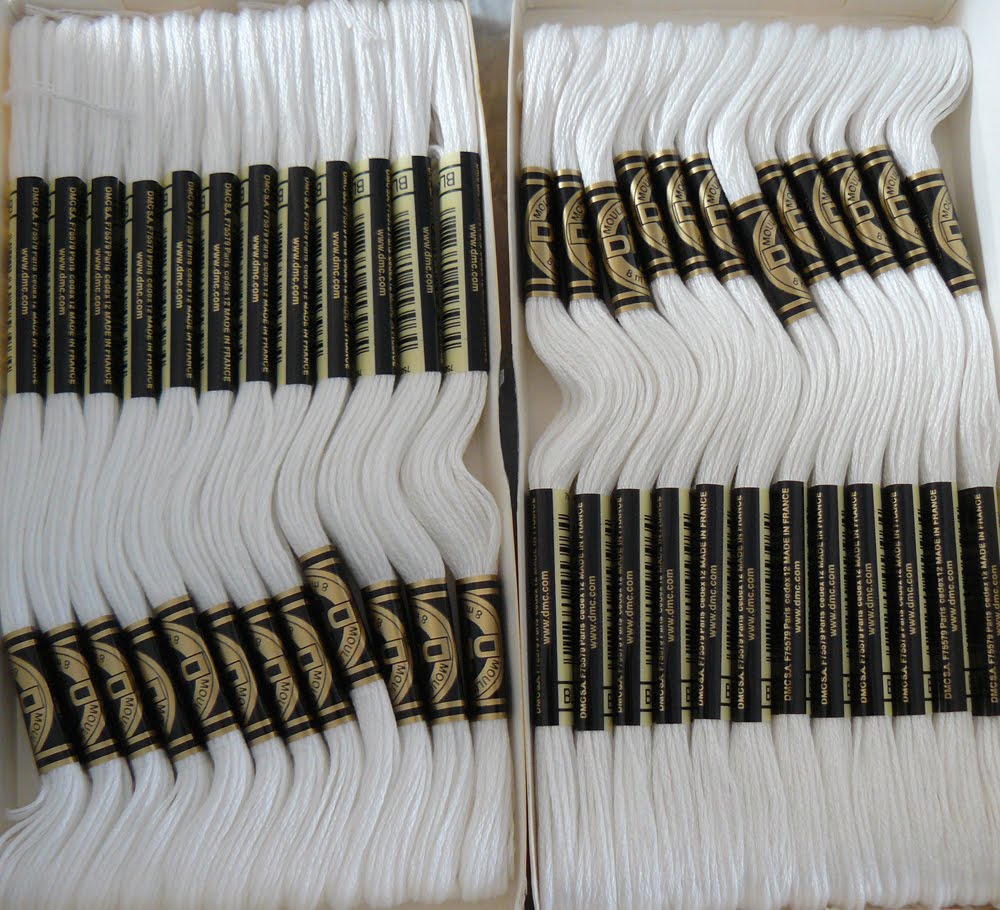
Two fresh boxes of DMC blanc ten days ago. Three skeins left.

Thursday, March 25, 2010

My Antarctica

It's only taken me ten days to stitch the 1500m contour. Sooner than I expected, I find myself at the edge of the plateau and the way off is steep and treacherous. I'll be adding the final countours even faster I think; a downhill race if all goes well; or a bum-shredding slide if things get twitchy.

My poor health of the past week has helped the acceleration by excusing me from almost every activity except work and Antarctica. My normally passionate relationship with food has been betrayed, so that I have a more visceral response than usual to reading about starving Heroic Age explorers.* As Shackleton, Wild, et al march to the 89th parallel on half rations (1909), I am drifting through my days on mint tea and honey and not much more. They were glad for a sparse meal of old horse-blood gravy after months of half rations. I may be fantasizing about chocolate gateau but I nervously approach even miso soup.

I'd miss food more if I was so sick I couldn't stitch, but fortunately embroidery is one of the few activities that doesn't make me feel worse. As it is, less time spent shopping, cooking and eating means more time for stitching. Hurrah!

But looking down the steep, slick, icy slope towards my destination, I have mixed feelings.

I don't want to finish my Antarctica, because then it will be over. I'm in love and never want this stitching to end.

I do want to finish my Antarctica because I am looking forward to getting to work on other (related) projects.

I don't want to finish my Antarctica because when I'm done stitching, I'll have to deal with hanging, photographing, packing, storing, shipping, pricing, naming and showing a really big, unconvential, artwork that from a distance will look like a pale blob.

I do want to finish my Antarctica because will be a big, bold, meaningful piece and I want it to have an impact on the people who see it.

I don't want to finish my Antarctica because I always love my own art most while I am making it, and least as soon as I have finished it. My love affair will be over and I fear for a broken heart.


*Currently engrossed in a somewhat irritating account of Shackleton's 1907-09 British Antarctic Expedition.

Thursday, March 18, 2010

Obsession

I worry that if I harp on too much about Antarctica the internet will get bored with me and go away. But I have nothing else to say really. It's an obsession but one that I monitor carefully to ensure I can continue to maintain sufficient internal and external resources to safely indulge it.

Update: I have added another contour now, and at 1500m the piece is now too big and too stiff to fit on the tapestry frame. I alternate between working with it spread out on the table or draped across my lap. This contour means I've crossed the halfway mark now, with only three more layers left to add. Out at the edges of the continent it's mostly very steep, so my stitching follows longer lines and fills in narrower widths.

Although still months away, I feel like the end is almost in sight as progress seems swifter, probably because the rest of my life has been streamlined simply to support several hours a day of stitching. There are a great many other things I could (and sometimes should) be doing, but all I care about is filling in the great white ice fields, stitch by stitch, step by step.

A potential bottle neck appears as I start running short of DMC blanc embroidery thread. I am going through two or three skeins most days. To get the quantities I need I have to place a special order at the Bernina shop in town, but there was a misunderstanding last month and my order never came through. I've reordered but I'm down to my last couple of skeins, not knowing when the two boxes on order will come through. And I'm not entirely sure whether two boxes will last me until the next time I can order. The thread is the most expensive material for this project and unfortunately I can't afford to stockpile.

A quiet thought sometimes occurs that if I do run out of thread for a few days I might catch up on the writing, accounting, cleaning and other mundane obligations that are not yet urgent demands, but will become so eventually if I continue stitching so obsessively. As a great sacrifice I have not touched a needle this morning, instead rearranging my little studio home for winter. Somehow, sorting out everything else I live with has left the great roll of loose contours adrift. It's a long white sheet-shrouded sausage which is now sitting forlornly across most of my table, not a convenient place since the table really needs to be clear for other purposes, such as stitching.


Even when I put Antarctica to one side for a few hours, it still dominates.

Thursday, March 11, 2010

Afternoon Tea at the Hospice

Martha Simms with Dudley Cleland (painter of this picture)

It was an attractive opportunity- the once-only chance to see a collection of work by some of the Waikato's finest artists. But when it came time to get on my bike and on my way there, the real incentive to leave behind the thrilling, demanding, compelling, satisfying challenge of adding the 1500m contour onto my Antarctica, was the promise of my mother's superlative home baking.

South Pole (detail of just completed 2000m contour)

The event was the Waikato Society of Arts (WSA) tour of the brand spanking new, soon-to-be-opened community hospice filled with a fine collection of art donated by WSA members. As soon as the Hospice opens, the space becomes private of course, and even if you were dying, or visiting someone dying there, you'd never see the pictures in other people's rooms. So it really was a special once in a lifetime opportunity to see the all art and have a nosey around the hospice.

Mary de Lisle prints by a bed

The hospice is the fruit of many years of community fundraising, a converted motel in an excellent location (though hair-raising to access by bicycle- but I guess cyclists aren't assumed to be the primary users). It looks brand new and purpose-built: all contemporary design; light and airy and peaceful. I feel quite proud to live in a community that has created such a sensitive facility.

The WSA-donated art looks great. There's several pieces in each of the private rooms, and other works distributed through the lounges, halls, library etc. The curating is very sympathetic, and it made a nice change to see an art collection in a setting that bridges the public/private divide usually staked out between art galleries and homes.

Lola Badman's landscape in the Visitor's Lounge

My mother not only baked the delicious cookies for the afternoon tea to thank the WSA art-donors, but as President of the WSA she was the driving force for collecting the art for the Hospice. In many cases she visited artist's homes and delighted in the chance to see private collections of art produced over careers spanning many decades.

Studies have shown that abstract art is less calming for sick people, so the emphasis was on more realistic work for the Hospice. This could have turned out very naff, but didn't. As I looked through the rooms I imagined what it would be like to gaze at the pictures from my death bed, and liked that most of them offered windows into attractive and/or realistic landscapes. Other than the faces of my loved ones, I think I'd like the last thing ever I see to be a beautiful place.

I always get a small secret thrill when I see flower arrangements with miniature pineapples, as they are grown by friends of mine in the Far North.

Friday, March 05, 2010

Snapshots of my life in Antarctica

This photograph represents my attention (when I am not at the paid-job of course). At least 90% is filled with the repetitive white on white of remaking my imaginary Antarctica, laced with stories from the Heroic age, YouTube videos of Emperor Penguins, mild anxiety about technical problems and daydreams for the future of this big ol' blanket when its done. No more than 10% of my attention is taken up with the rest of my life, my Etsy shop (which has had a rockin' week!), my bicycle problems, making my new home nice(r), community activities and other stuff like food and hygiene.


What my eyes are focused on for hours a day. I do take plenty of breaks, generally involving an email and Facebook check-in, food or exercise, and/or reluctantly, some necessary task on the list that rolls over day after day of 'stitch Ant' getting most of my time and energy.


Self-portrait while stitching. The shadowy image in the background on the right is my pencil map of Antarctica's contours; the big picture contextualising my inside-out, top down, contour by contour, stitch by stitch, process.

Wednesday, February 24, 2010

'Great God! This is an awful place'*

Felting needle

Even though it happened 98 years ago; even though I've known the ending of this story most of my life; even though I have read,watched and heard dozens retellings in the past decade of pursuing my passion for Antarctica; I still find myself sleepless with anxiety for Scott's Polar Party.

A thin layer of undyed wool roving between the blanket contours

The past few days I have been immersed: in the mornings stitching the great empty waste of East Antarctica onto the contour that meets the tops of the Queen Maude mountains; in quiet times at work in the afternoons leafing through reproductions of Amundsen's lantern slides; in the evenings reading Apsley Cherry-Garrard's literate, harrowing, defensive and deeply sorrowful account of the Worst Journey in the World. Cherry is the most quoted of Antarctic explorers, for good reason, but this is the first time I've read his book in the original.

The tops of the Beardmore Glacier (Scott's route) and the Axel Heiberg Glacier (Amundsen's route)

There is something immensely moving to be stitching over the miles covered by the final five who went to the Pole with Scott and never returned, at the same time as I am reading about the support parties who were battling their own awful journeys and ultimately waiting with fading hopes for Scott's return; with my minds eye illustrated by Amundsen's snapshots of his own 'dream run' to and from the Pole a month earlier than Scott.

The dark basting marks the South Pole (Amundsen 14.12.1911; Scott 17.1.1912)

I am so cross with Scott (no doubt influenced by recently reading Huntford's attack on him) as it seems unforgivable to have made so many poor (sentimental, impetuous, arrogant and ignorant) choices that led to the death of such fine men. I identify much more strongly with Amundsen, being more attracted to pragmatism than romance. Amundsen's triumph (always seen in the shadow of Scott's tragedy) was the result of careful considered planning and decisions at every stage.

A nice smooth contour of East Antarctic ice dome- no worries there

Some of my current Antarctic anxiety may be related to the challenges of adding a new contour. My technique, although trialed on with reasonable success on Ross Island, is by no means a reliable approach for this much larger work. I am constantly questioning my methodology and trying to improve the results. It's not as hard as man hauling through blizzards with scurvy, but it's still a challenge. I want desperately to live up to Amundsen example, but I fear I share many of Scott's weaknesses.

* Robert Falcon Scott, on reaching the South Pole, second

Saturday, February 20, 2010

Home, and Away with Antarctica

My new home/studio is really just a single bright, light, room (plus bathroom) that I've divided with a couple of large pieces of furniture. I was given a set of open shelves that are keeping the kitchenette separate and not too cluttered; and I've used the giant book (You are Beautiful) I made for the Domestic Pilgrimage exhibition, to screen off a sleeping and storage area. Surprisingly, dividing it up into three small 'rooms' makes the whole space seem bigger than when it was just an open-plan box.

My stitching chair shares a cosy corner with a bookshelf and some sentimental treasures..

I've unpacked everything that needs to be unpacked, and while there's still some judicious sorting and arranging to be done (along with picture-hanging and acquiring some drawers for my clothes), it feels homey enough for me to turn my attention elsewhere again. Finally getting the phone and broadband connected have made all the difference!

For the first time all my bits of bleached coral are together, on the bathroom windowsill

I'm back at work on my stitching. I have a comfy chair just the right height and depth for working on my tapestry frame. The lighting is just right, my solar radio sits nearby on a sunny window sill so I can listen to my beloved Radio New Zealand National (while I still can), or I can watch movies on my laptop (I have neither room nor inclination for a tv).

At work on Antarcica, on my granny-square-covered chair

In the past few days I've made good milage in Antarctica. I've almost finished the 3000m contour, which was virtually halted for more than a month by a blizzard of distractions and demands from the outside world. Finishing this contour is an exciting landmark for me. So far I've been embroidering my way concentrically outwards from the centre of the ice dome's smooth curve. My hours of repetitive blanket-stitch are about to be interrupted by an off-the-tapestry-frame flurry of measuring, pinning, needle felting, before I take up my steady slog through the snow again. The next countour will bring the first taste of the jagged peaks that form the rim of the continent's ice filled bowl.

Saturday, February 13, 2010

Big weekend

Reading poems to the big blue folk
Waikato Times 13 February 2010
Don't be misled by the headline.


Click on the article and it should zoom in big enough to read.

I'm packing today, moving house tomorrow... will post properly when I settle in.

Saturday, February 06, 2010

Good news and bad news

Two lots of good news to report; but briefly, due to the consequences of my bad news. Please do follow the links to find out more details than I have been able to include.

Breathe, my mangrove piece, has been selected as a finalist in the Uxbridge Estuary Art Awards 2010. I made the French knitted pneumataphores especially for the Awards, which encouraged research into the environmental issues facing the Tamaki Estuary. I was excited to have an opportunity to finally realise some of my ideas for representing mangroves in my art.

The Estuary Art Awards exhibition open on Thursday 11 February at Uxbridge gallery in Howick. I encourage Auckland readers to go along and see all the finalists. The exhibtion runs until 10 March.


The other bit of good news is that one of my poems, Two Kinds of Time, has been nominated for the 2010 Rhysling Awards. This poem just seems to run and run! Written for, and first published in the Voyagers Anthology, it also inspired me to make a (very) short film and a limited edition artist's book (which has sold out).

Tim Jones, one of the editors of the Voyagers Anthology took the initiative to write a media release about the nomination, which you can read on his blog, as well as on Scoop and Beattie's Book Blog. I'm very grateful for Tim doing this, since I am still devoting all my energy to my temporarily fulltime 'straight' job.


Bad news: yesterday on my way to work I was knocked off my bicycle by a driver opening his door suddenly. Fortunately I was riding very slowly so no great damage has been done. I am shocked, shaken and a bit bruised; my knuckles took the brunt of the collision of handlebars with door. I'm taking the accident as a sign of having reached my limit for full-time work, so intend to negotiate down to part-time hours by the middle of next week. Next weekend I'm moving, and then once ensconced my new studio-home, I look forward to blogging progress on my own, actual, creative practice again.

Saturday, January 30, 2010

Mexican Train Dominoes

I'm having a bit of a break from stitching and other creativity while I focus on generating some reliable income to support future art activities. For these few weeks I'm doing fulltime work at a computer which means that the last thing I want to do in the rest of my time is more computer- so blogging, twitter and facebook are all neglected. And while I would love to do some stitching and making, I can rarely summon the energy and focus to trust myself on anything that matters. Plus I need to rest my hands from all that typing.

Thus I am finding myself at an unfamiliar loose end in the weekends. I understand it's what's considered leisure time: this non-productive, unstructured couple of days, when my sole goal is to stockpile energy, clean clothes and easy food for the coming week.

Besides cooking ahead and doing laundry; taking lots of naps on the bed, the sofa or the hammock (thanks Matt); and daydreaming endlessly about the live-in studio I move to in a couple of weeks; I have also been playing games. For example, Mexican Train Dominoes with Anna. Very good fun. Almost fun enough to compensate for having been airlifted out of my Antarctic adventures for a few very hot and humid weeks of regular working life.


NB Full time work will give way to part time work later in February,when I will resume my usual activities, and blogging about them. Meanwhile, you can look forward to the occasional post about something unrelated.

A special book

The book comes in a convincing faux-tin slip case, representing the real tin box in which Dreyfus stored his journals to protect them from the paper-ravaging conditions on the island.

I was lucky enough to get a close look at a very special limited edition book, recently acquired by my father for a great sum. Cahiers de l'isle du Diable presents the journals of Alfred Dreyfus written while on Devil's Island. The book is in French, so I can't say anything much about its content, but Editions Artulis/Pierette Turlais have made a beautiful book object as a limited edition of 30o (published in 2009).

One of the most fascinating aspects of the book for me is the exposed spine, visible even when the book is in its slipcase. Usually a book's spine is only deliberately exposed to show off fancy hand-stitching. This book appears to have machine sewn signatures with a slight sticky memory of book glue, the sort of spine that is inevitably hidden inside a cover.

The practical advantage of this kind of spine exposure is that the book can easily be opened flat, without any damage to the cover.

I'm guessing that the designer included this feature as another representation of the original conditions which Dreyfus was writing in 1898. Was it usual then for blank notebooks to have an exposed spine? Although the spine does not conform with popular book arts ideas of a spine worth exposing, it appeals to my post-modernist sensibility, and in combination with the faux-tin slipcase, offers a strong, edgy, industrial first impression.

Easing Cahiers de l'isle du Diable out of the slipcase, my industrial first impression of was immediately countered by the soft faux-vellum cover of the book itself. The front pages are also transluscent paper, allowing multiple pages to be perceived simultaneously from the outside, inviting one into the book. The paper's transparency is deceptive, as my father tells me that the contents of the journals are opaque, enigmatic and contested by scholars (not unlike the life of Dreyfus himself).

The cover, and the first section of the book are fascimile, photographic reproductions of Dreyfus's actual journal pages. These are heavily decorated with repetitive images, doodles mostly based around an X, embellished with more or less symmetrical lobes and curves to seem organic: as in pictures of brains or intestines or other organs/organisms.

Even the edges of the pages, on all three sides, have been printed with the doodles.

Some pages are entirely filled with these doodles, while others have Dreyfus's neat copperplate handwriting and occasionally an engineering or mathematical diagram. Dreyfys was imprisoned on Devil's Island for five years, and filled thirty-odd journals during that time, but only three of them survived to be included in this book.

Dad invested in this book as reseach towards a book he is writing about how the Dreyfus Affair transformed the collective imagination at the turn of the twentieth century. Early in the twenty-first century, this publication exemplifies a contemporary phenomena transforming our ideas of books from neutral technologies for storing/dispersing words and images, into art objects which embody imaginative technologies for sharing complex experiences, memories and projections.

Wednesday, January 20, 2010

Gully Intrigue


Hamilton doesn't really have hills, but instead is riven with many gullies, like hills in reverse. One of these is near my present home and across the road from my old primary school. When I was little, my friends and I used to play on the edges of its impenetrable wild, weedy, scrub. More recent walks along Grey Street have allowed me tantalising glimpses of the gully transformed into an impeccably groomed lawn, cut by crisp, white concrete paths on which I've occasionally seen people walking.


Curious, I've wandered all the nearby streets trying to find an obvious way into this half-hidden park but with no success. In yesterday evening's sultry heat I was determined to solve the mystery for once and for all. On Beale St I found a path leading down to a small, scruffy, clearing smelling of sewage or dead things, between Boys High and Marian School. Not the right place or the right ambiance, so I retraced my steps and then entered the grounds of Boys High.

I've avoided that Beale St shortcut to Boys High for my whole life, even though it was the obvious short cut to my intermediate school. Back then I was too self-conscious and scared to walk through teenage boy territory, so for two years took the long way round. I wonder if something unpleasant did ever happen to me there, because I continued to avoid it even as an adult. Yesterday I told myself I am too old to care what anyone, let alone unknown teenage boys, think of me and finally used that track alone.


Once on the school grounds I followed the border between Boys High and the NZTC, seeing the elusive park more clearly than ever through the high barbed wire fence. My desired destination was obviously part of the NZTC grounds, and when the Boys High track petered out in a over-grown swamp I turned back. This time as I passed the NZTC the entrance was swarming with people, and I could hear choruses of amens coming from the windows.


Wondering if I would fail in my objective to enter the gully that evening, I walked back along Grey Street looking hard for any other access points. Suddenly, I spotted an open gate half way along a private right of way. I quickly ducked through the gate and down a steep gravel path and lo! I was in the park. A great expanse of velvety lawn stretched in front of me, broken only by lush flower beds, and beyond a beautiful orchard and vegetable garden.

I had the whole large area to myself, except for a few ducks behind a dam. In it's silent emptiness it reminded me of the description in Robert O'Brien's The Silver Crown (one of my favourite children's books) of the grounds of the black castle where Ellen rescued Otto from brain washing. The black footpaths in the book were one of the mechanisms of mind control for kidnapped children. That creepy association, and my fear of being told off for trespassing, somewhat spoiled my walk in the park. And now, with my curiosity sated, I'm not sure I want to go back again.

Tuesday, January 12, 2010

Mail Art Delights

I've started new job this week, a straight (non-arty job) that will eventually be part-time in the evenings but the intensive training is full time every day for a while. Regular office hours are proving a chrono-shock after a couple of years of unconventional and mostly self-directed timetabling. So it was a lovely surprise to come home at the end of my long day to find this slid under the door.

Feel free to send me interesting snail mail at this address, but soon, as I'll be moving (again)!

One of the pleasures for me of snail mail activities is that I retain no expectations in my short term memory. It can take a week or more to receive the swapped zine, the Etsy order, the promised present or in this case the mail art postcard... and I have inevitably forgotten about it, until it arrives.

The front of Asta's postcard

I found out about Asta's mail art project on Facebook, and sent her my address because I always leap at the chance of interesting snail mail. When her mail arrived, it was an extra delight to see my postcard is a microscopic photograph of some moss that Asta grew herself! As you know, I like making a bit of mossy art myself, and so does my flatmate Adrienne Grant who was brewing up moss-growing concoctions last year.

The back of Asta's postcard

Another nice surprise was Asta's warm and personalised message on the other side of the postcard. But when I picked up the envelope again, it felt curiously heavy and sure enough there was more! Cute stickers! ~which will embellish my next few outward-bound items of snail mail. And a PS note:

Because I really want to send LOADS more of these postcards, perhaps you could help me, promoting this idea to your friends. Addresses can be emailed to aska(dot) doll (at) gmail (dot) com Facebook Group Mail Art Project. THANKS SO MUCH!!!!!!! :-)

An envelope full of delight

Go on, you know you want to!

Thursday, January 07, 2010

Shifting Margins

Antarctica: slow and steady


Ice flows
in long deep breaths
out of the mountains
grinding valleys and canyons
into boulders and dust
carried, eventually, out to sea.

I pant, I flood, I flicker
and soon disappear.

Ice melts, and sinks in the rising waters
hills become islands
and continents creep
driven by shuddering gouts of lava.

We fidget at the shifting margins
swatting new mosquitoes,
evolving new rituals,
engineering new brains.


Mangroves: finished